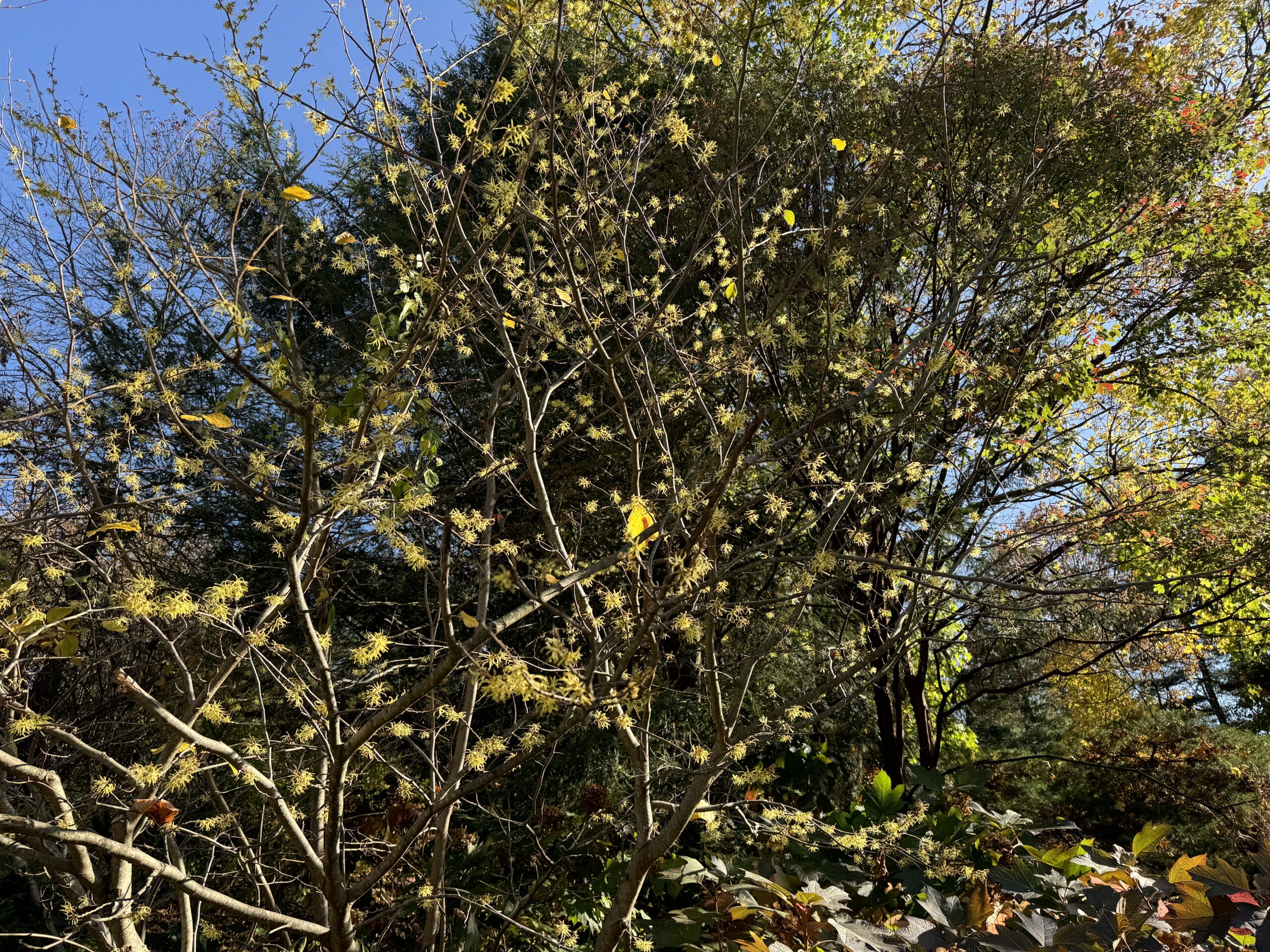
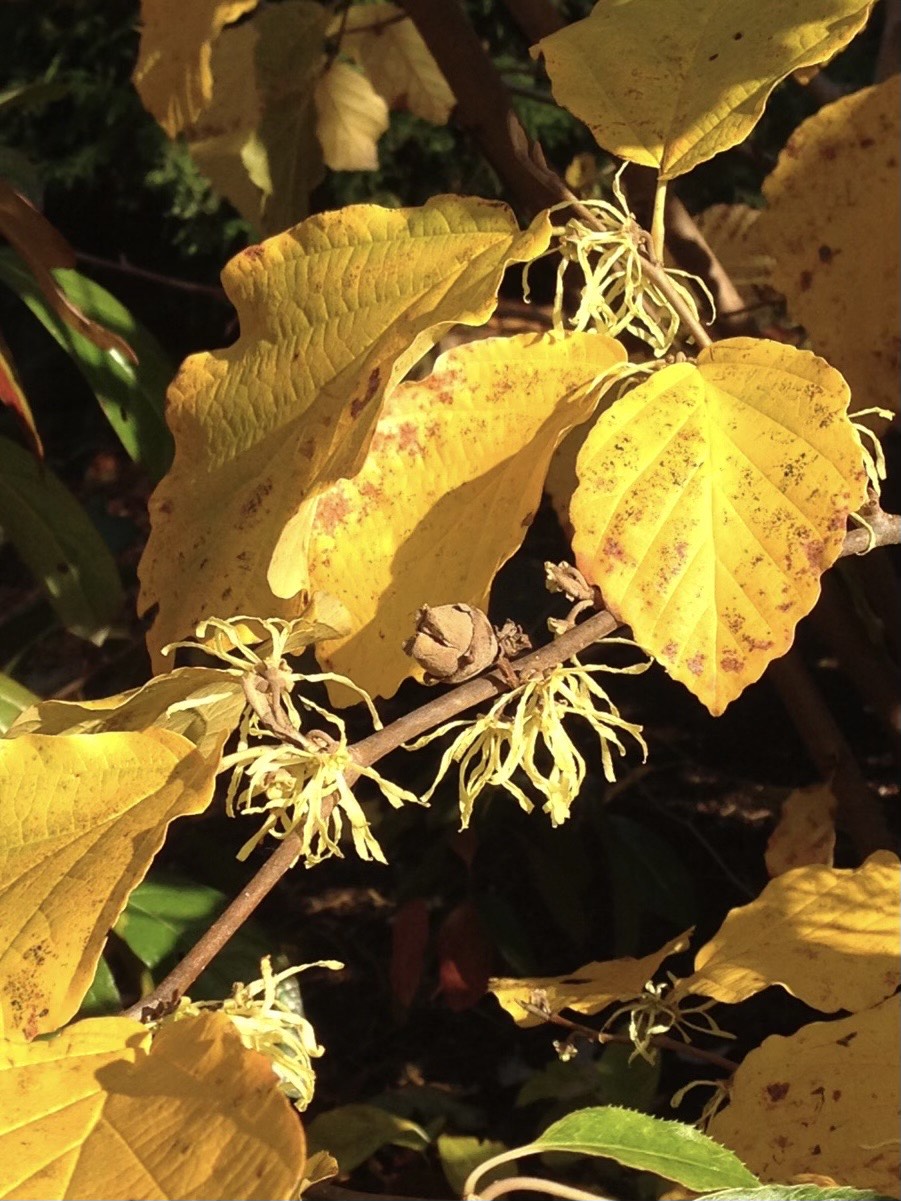
After Halloween and a little before Thanksgiving, Witch-hazel (Hamemelis virginiana) starts blooming. It’s always a surprise to see its bright yellow flowers appear just as fall colors fade and branches are bare.
Witch-hazel blooming in November.
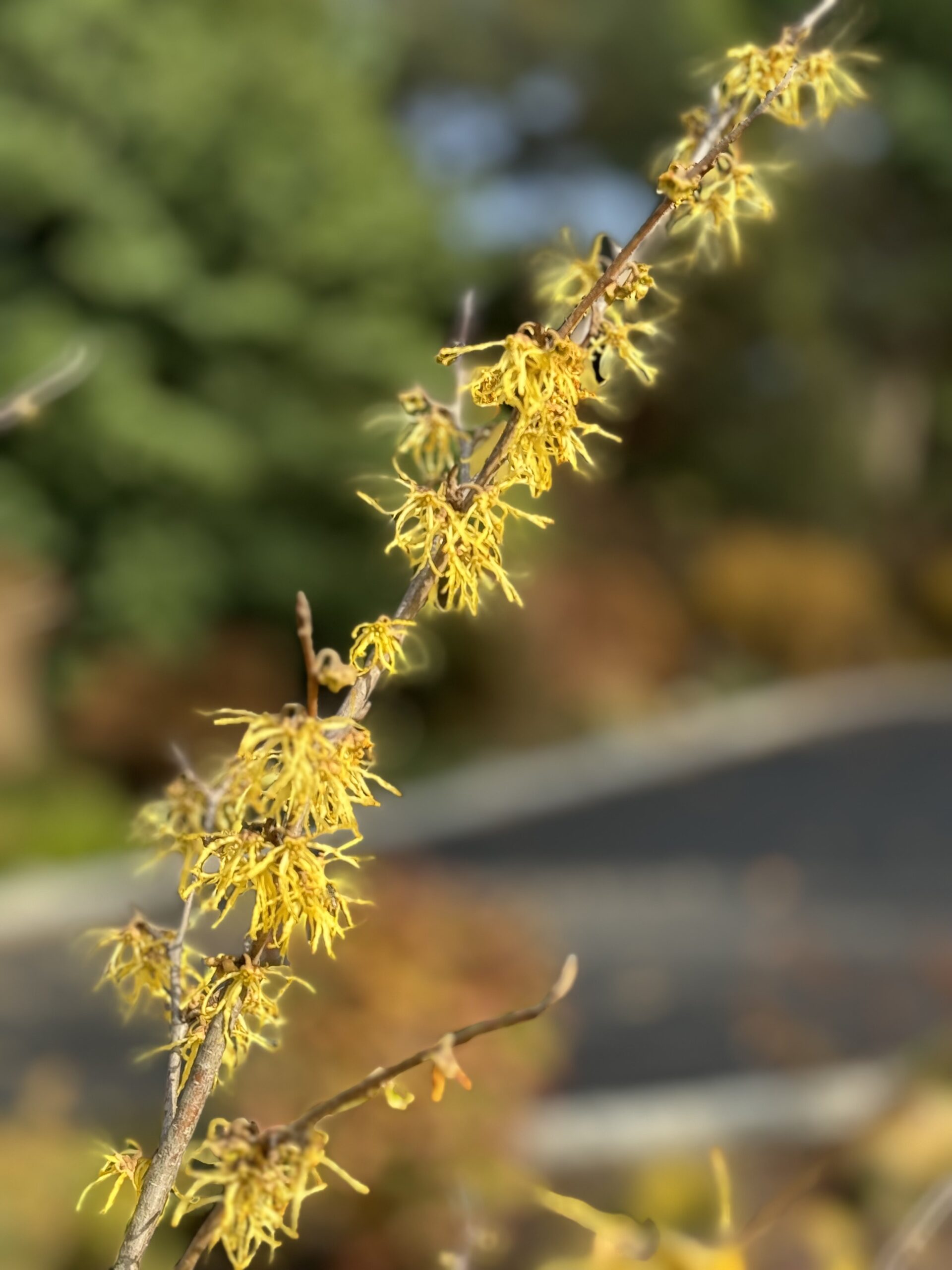
Witch-hazel is a fascinating plant. It’s a multi-trunked shrub or small tree that evolved as an understory plant in the forests of the Northeastern US. You might not notice it at all in the spring or summer when it sits modestly under bigger trees in part shade. But in early winter, when most plants are going to sleep, Witch-hazel is hard to miss. Its flowers are fragrant, and adorned with tiny yellow streamers reaching out in all directions.
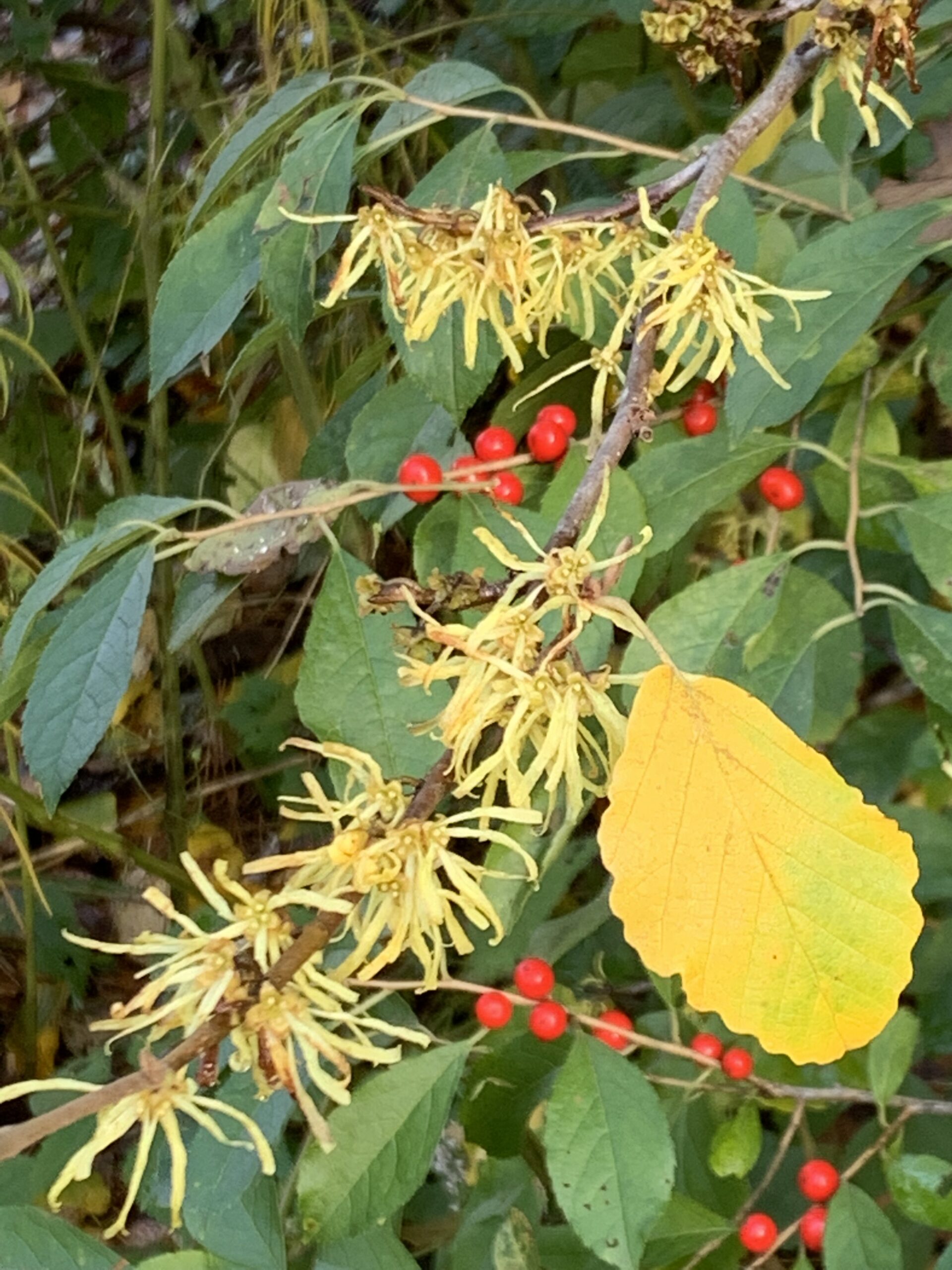
Witch-hazel’s unique flowers.
The leaves, bark, and twigs of Witch-hazel contain tannins and flavonoids that Native Americans used for centuries to treat skin ailments. European colonists soon adopted the practice, and today Witch-hazel is one of the few plants the Food and Drug Administration has approved for use in over-the-counter products. Many cosmetics companies use Witch-hazel in toners, diaper rash remedies, acne treatments, pore reducers, and after-shaves.
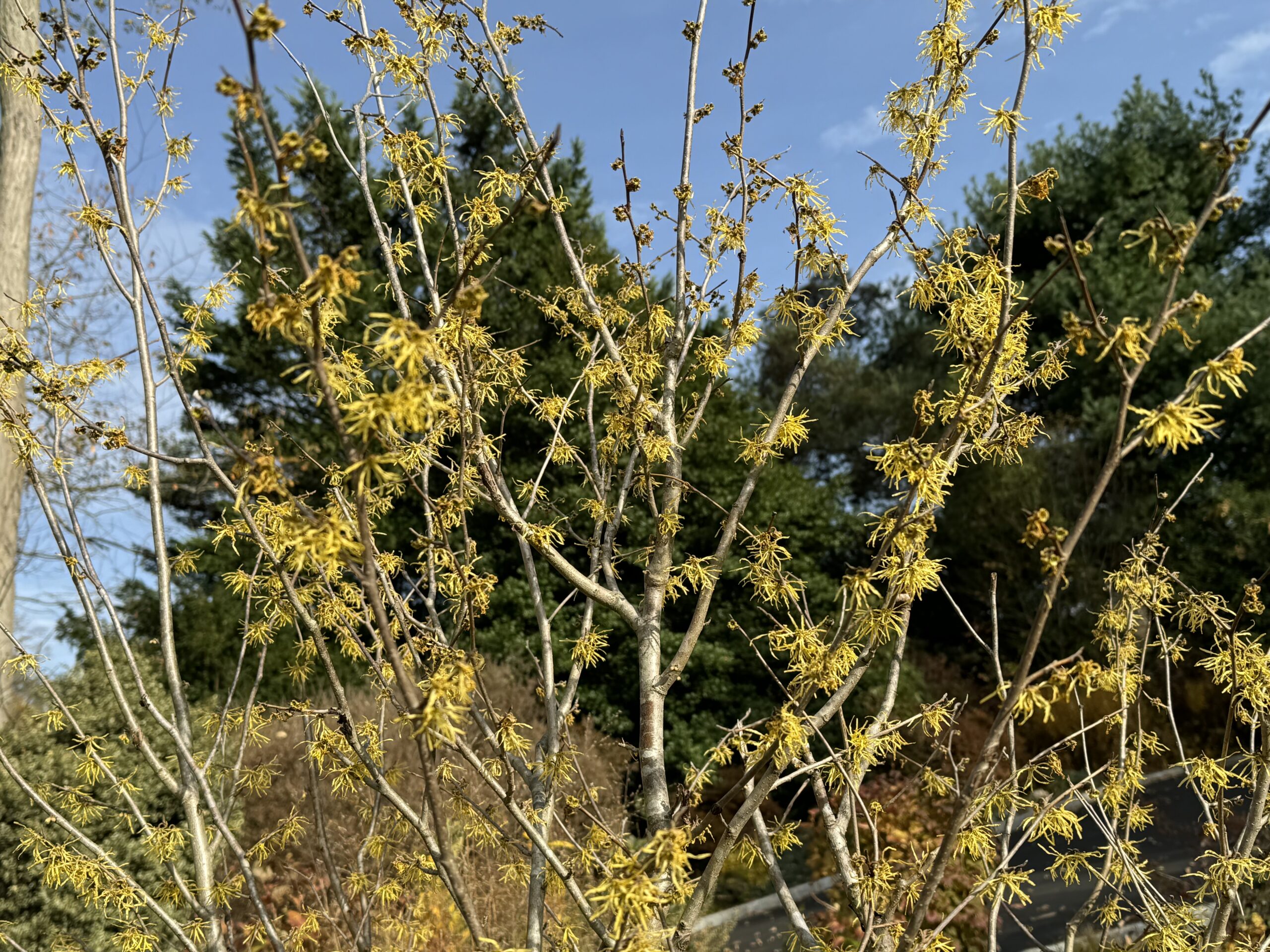
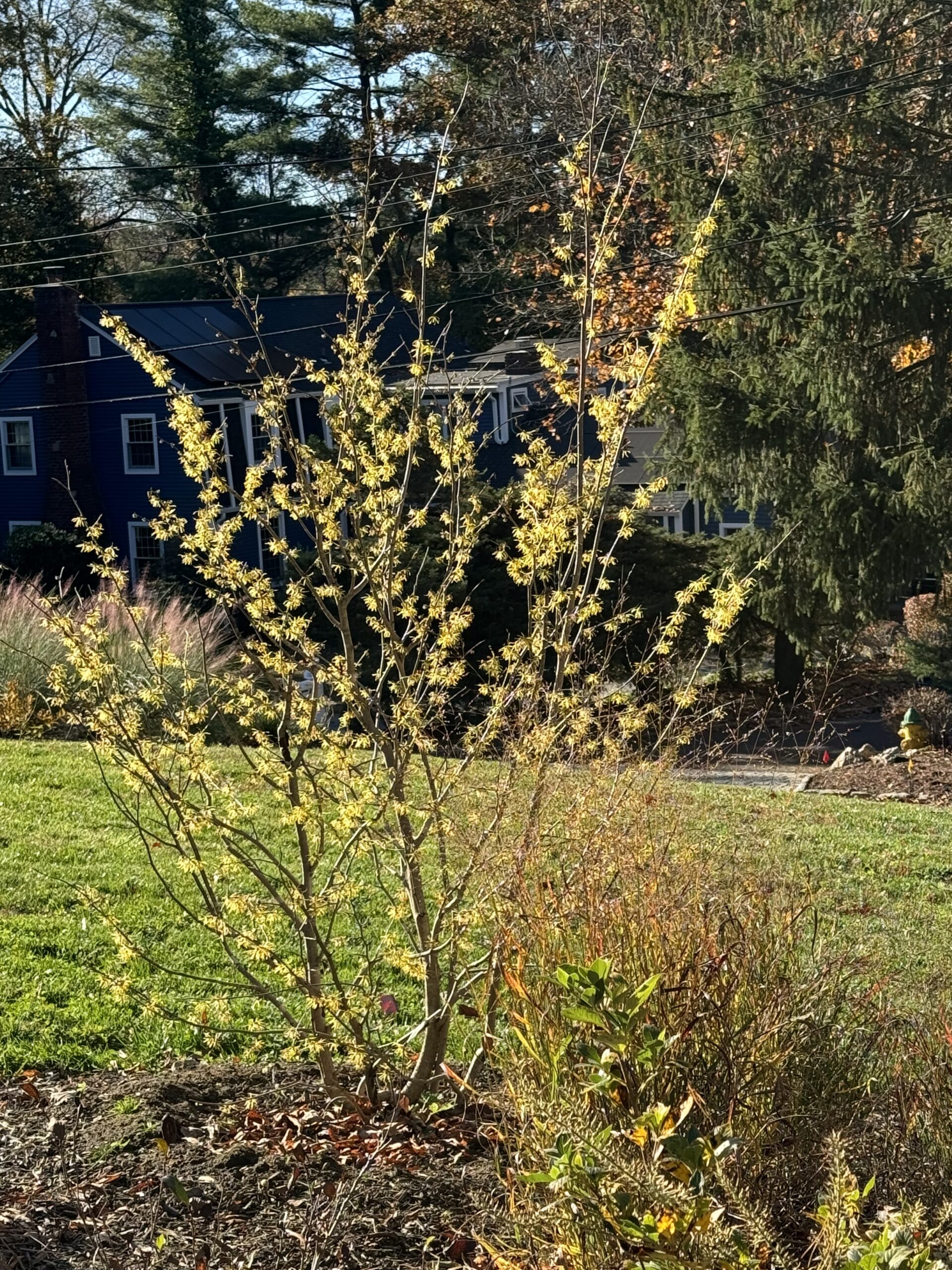
Blooming Witch-hazel stands out against an evergreen background in winter.
A more questionable early use of Witch-hazel was the practice of using forked branches as dowsing or divining rods to search for underground water. A “water witch” would hold the forked end of a Witch-hazel branch and walk until the flexible tip supposedly dipped when underground water was detected. Dowsing with Witch-hazel branches for well-digging was a common practice right into the 20th century.
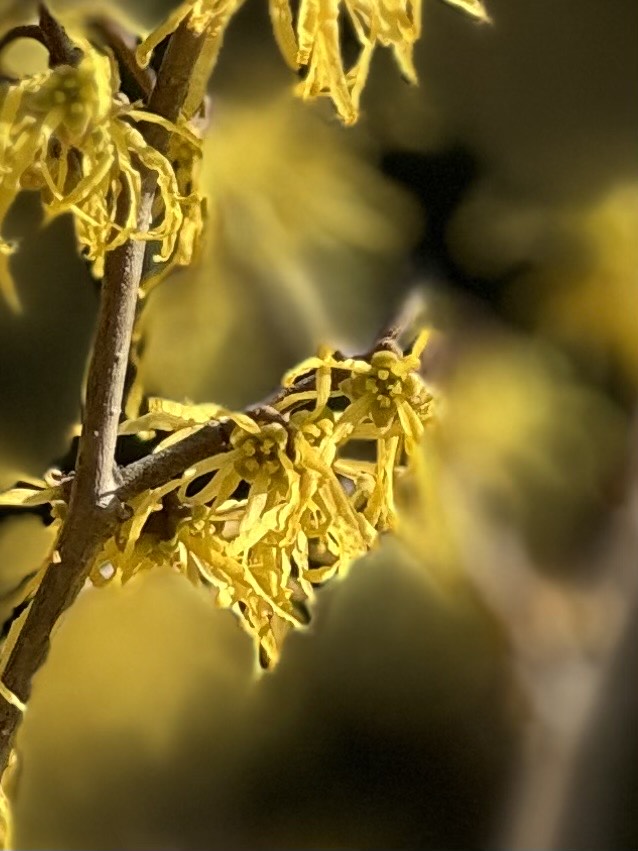
Witch-hazel flowers have nectar and sticky pollen, typical of insect-pollinated plants.
The real mystery of this plant still isn’t settled. Why does Witch-hazel start blooming in winter when most pollinators are already hibernating? And which insects do pollinate the flowers? Some researchers have pointed to a moth species that survives freezing temperatures by shivering so hard that its body is actually warmer than surrounding air temperature. Others have suggested that a small and very late-acting bee is the pollinator. Still others have theorized that swarms of tiny gnats do the job. More research is required.
But the coolest thing about this fascinating plant? Because of its strangely late pollination, there isn’t time for the seeds to ripen in the same year the flowers open. It takes the whole next summer for seeds to slowly ripen in their pod. Then, just as the flowers start blooming again in the freezing cold, the pod explodes throwing ripe seeds 10 to 20 feet away, where they will rest until spring weather is warm enough for germination. It’s a risky reproduction strategy, but it seems to work well for this native plant.
Seed pod almost ready to pop.
Witch-hazel is an easy choice for smaller properties. As a multi-trunked tree or shrub, it rarely exceeds 20 feet in height. It is an understory plant, so it does well in part shade under mature trees, but is also happy with more sun. It is winter-hardy in Zones 3 to 8, and is not fussy about soil, but average moisture and a covering of leaf litter throughout the season is recommended. No special care is required and Witch-hazel rarely needs pruning. In summer, it is an open, airy plant with medium green leaves, but in fall, the leaves turn apricot gold before dropping just as the crazy flowers start to open. The flower show typically lasts a month or more.
Hamemelis virginiana is an easy choice for suburban landscapes.
Lately, we’ve seen nurseries offering non-native hybrids of Witch-hazel for sale. These varieties with orange or red flowers are recent introductions of hybridized Asian species, so their value to our native wildlife and potential for invasiveness are unknown. Our view is that it’s always safer to go with species that evolved in our region.
Witch-hazel contrasts with Winterberry (Ilex verticillata).
Hamemelis virginiana, our native Witch-hazel, is a garden-worthy plant that brings late-season interest to suburban landscapes. Try it against a background of evergreens or with berry- producing shrubs. On a cold winter’s day, you won’t be sorry.
THIS BLOG IS WRITTEN BY CATHY LUDDEN, CONSERVATIONIST AND NATIVE PLANT EDUCATOR; AND BOARD MEMBER, GREENBURGH NATURE CENTER. FOLLOW CATHY ON INSTAGRAM FOR MORE PHOTOS AND GARDENING TIPS@CATHYLUDDEN.
It’s hydrangea season and they are everywhere! But where are the bees?
Have you noticed that bees happily buzz around some hydrangeas while ignoring others? The difference is striking with these two hydrangea shrubs seen blooming side-by-side:
What accounts for the difference?
You might reasonably guess that native hydrangeas would be more attractive to native bees than Asian varieties, because that is often the case with other plants. Insects in North America usually prefer the plants with which they co-evolved, so non-native species are much less useful to them. But in the video above, both shrubs are non-native hydrangea varieties. So, what’s the difference to the bees?
When it comes to hydrangeas, it’s the shape of the flower that matters – at least to bees! And since 25% of native bee species are in sharp population decline, we really must care about what’s important to bees.
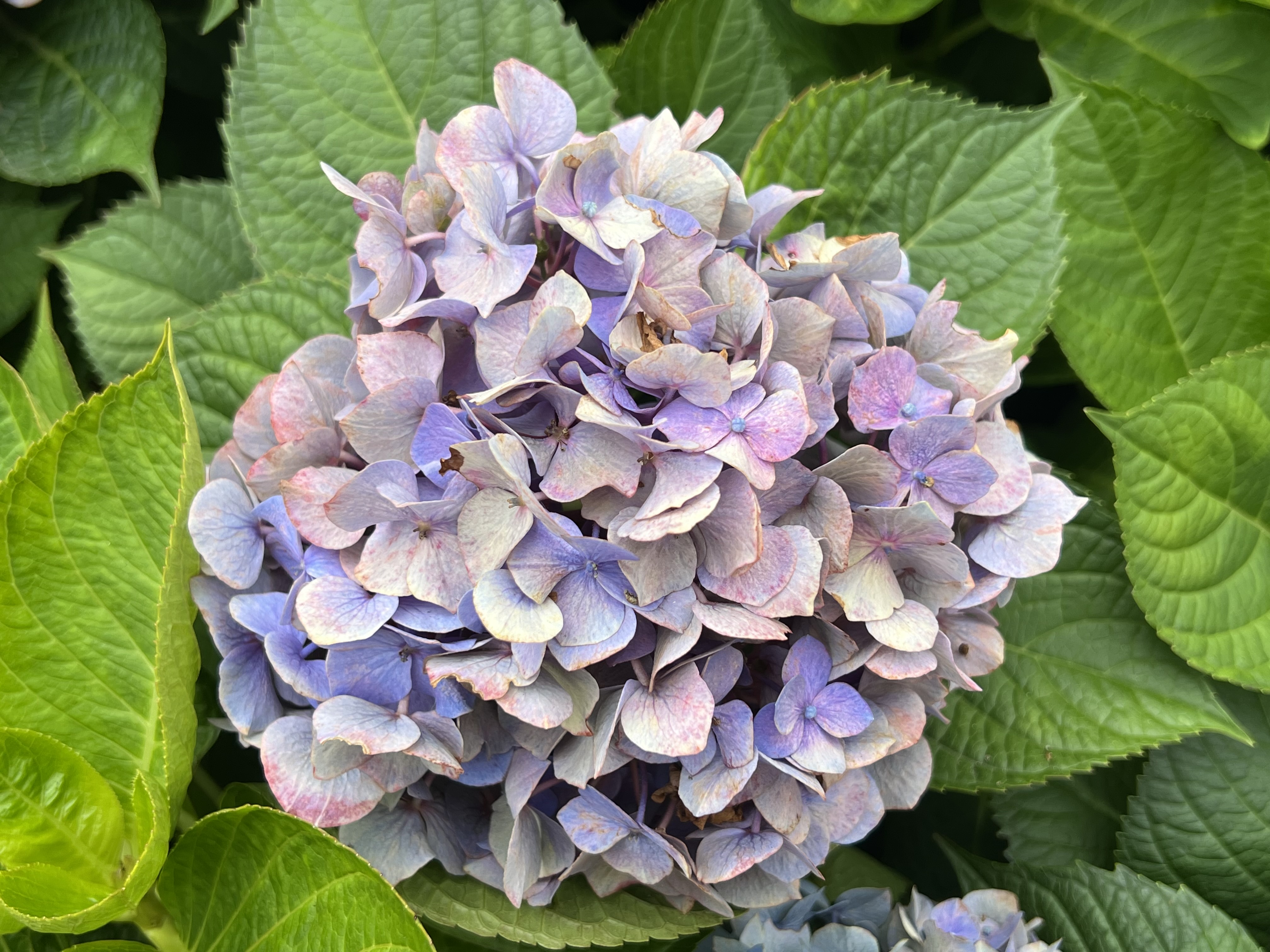
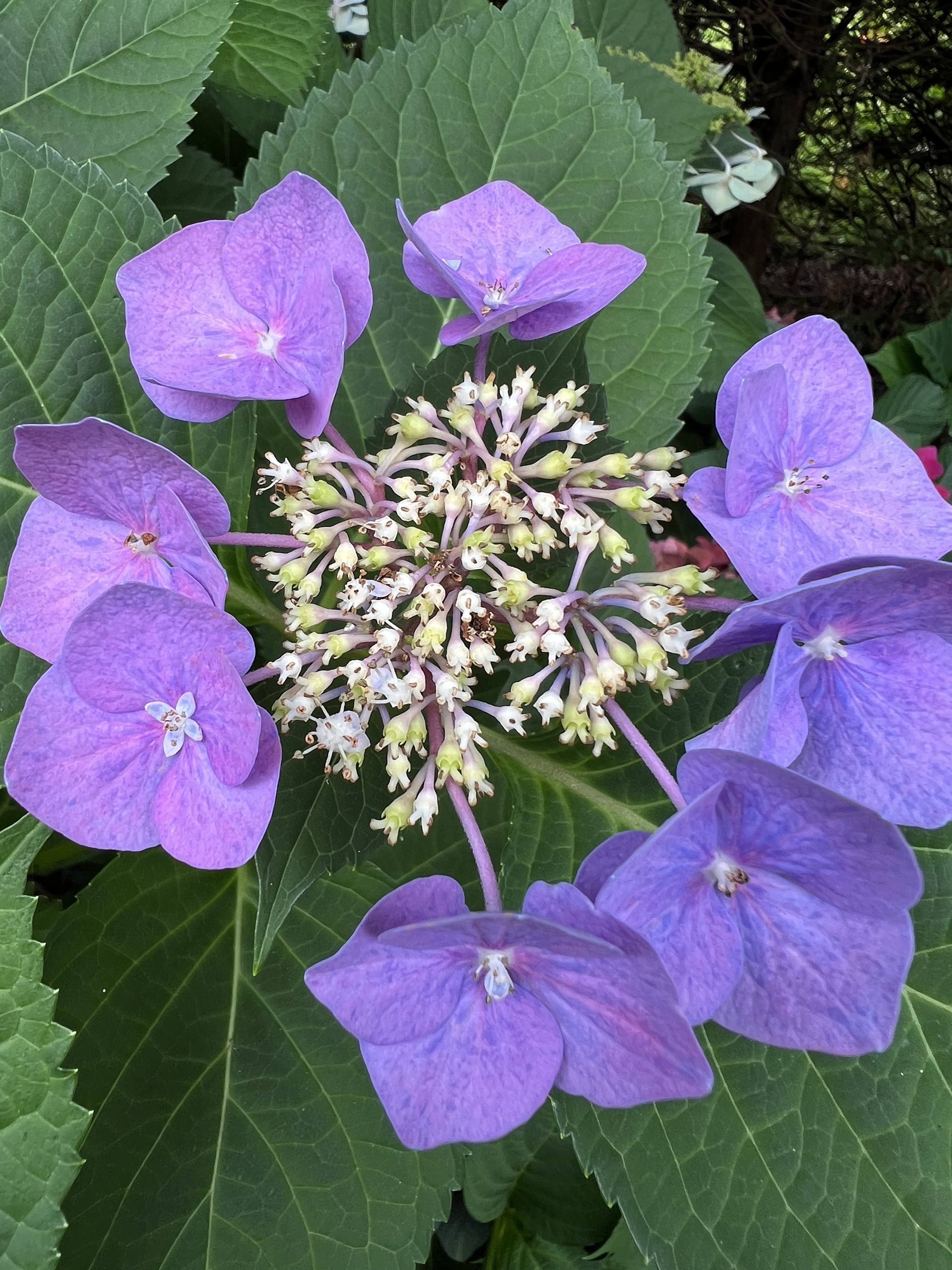
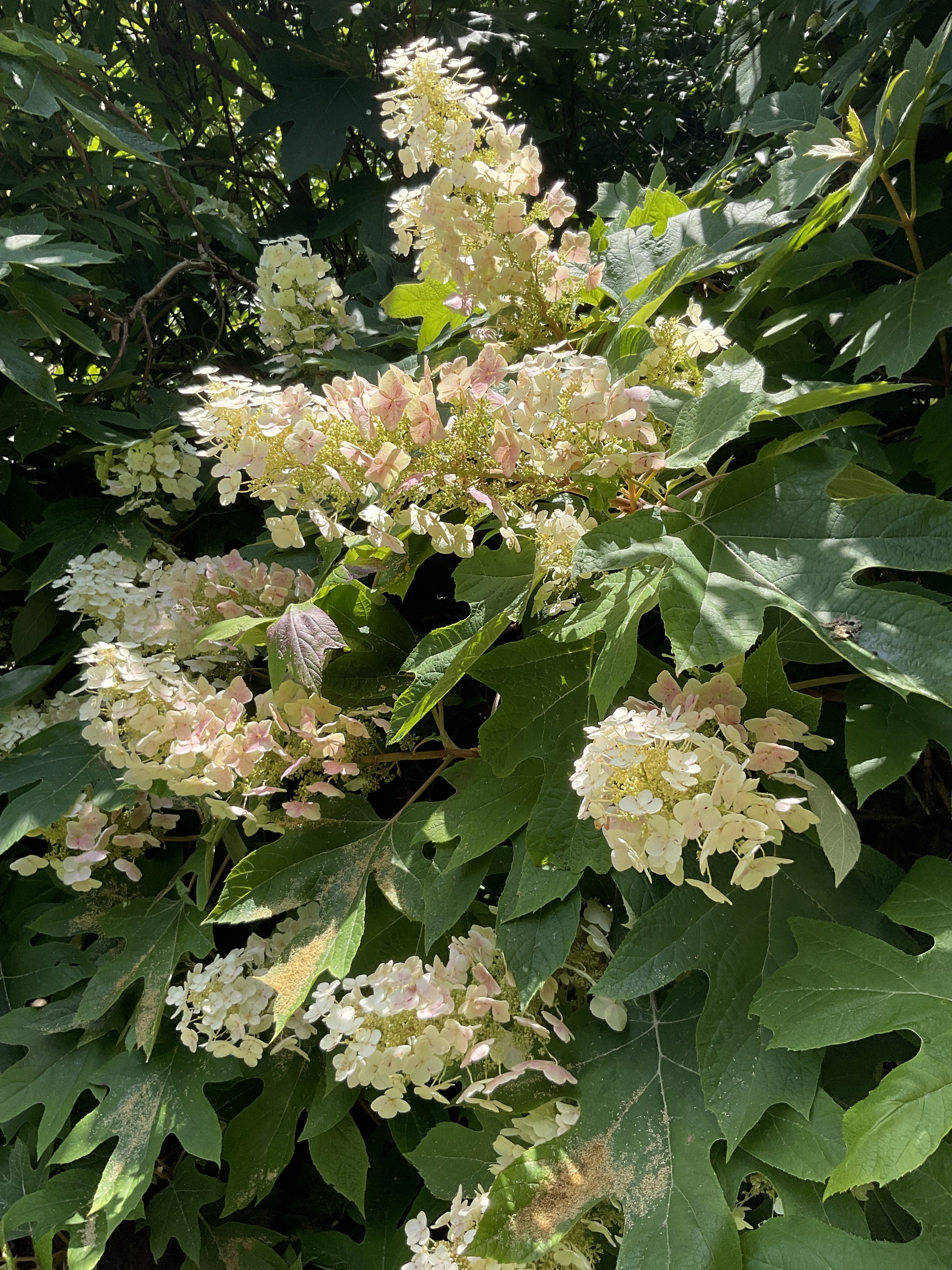
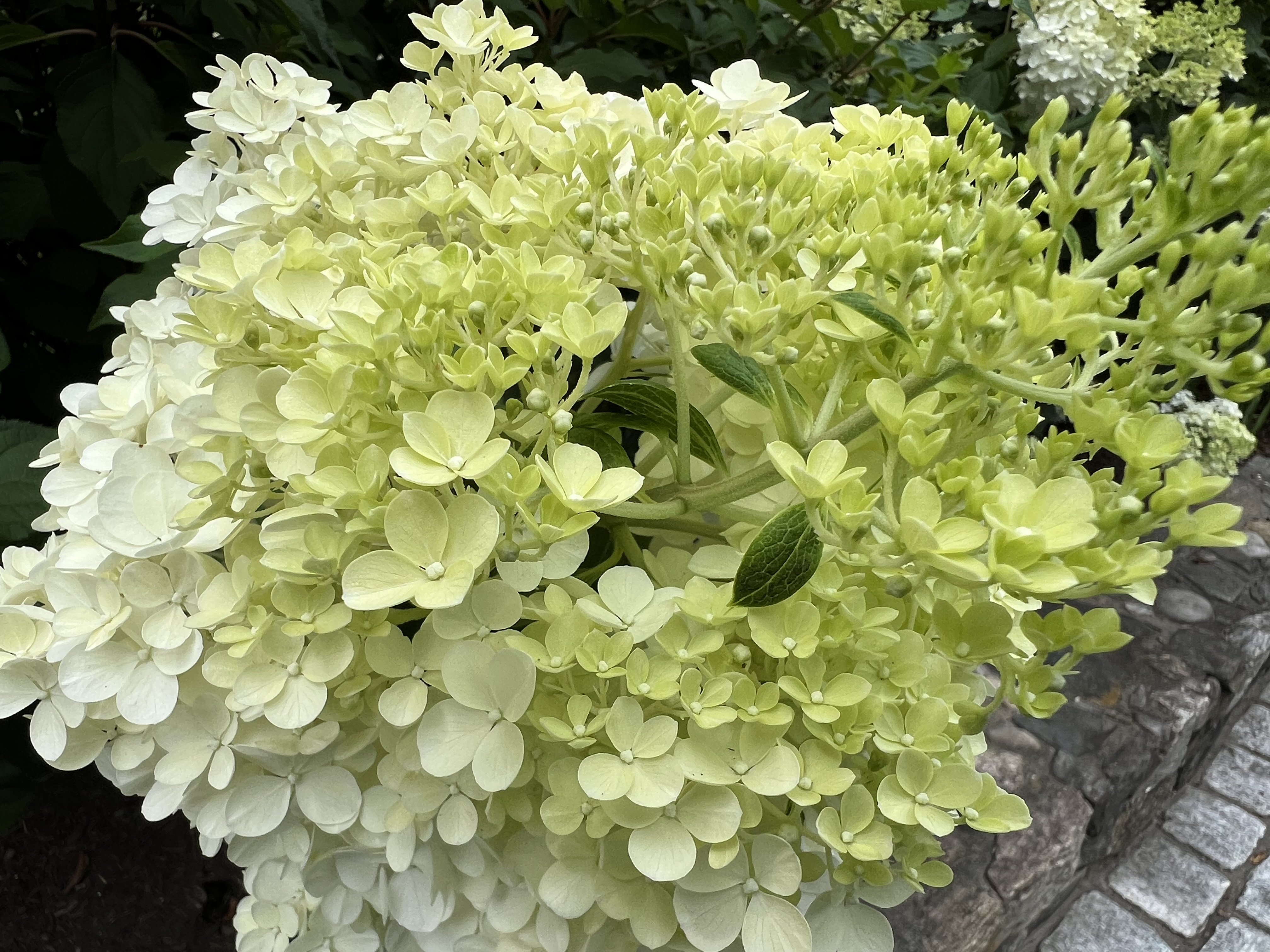
Hydrangea flowers, properly called “panicles,” are typically one of three shapes: “mophead,” “lace-cap,” or “conical” (cone-shaped).
Mophead
Lace-cap
Conical
In nature, hydrangeas have either lace-cap or conical forms composed of many tiny fertile flowers accompanied by larger showy 4-petaled flowers that are sterile. The only purpose of the sterile flowers is to attract the attention of pollinators, directing them to the real flowers – the tiny ones loaded with pollen and nectar.
Large sterile flowers draw attention to the tiny fertile flowers inside
Pollinators find nectar and pollen in the fertile flowers
For bees, the sterile flowers on hydrangeas are just advertising. For humans, the sterile flowers are the pretty part. So, for hundreds of years, humans have been manipulating hydrangeas with selective breeding and genetic modification to create panicles with more showy sterile flowers and fewer — or zero — fertile flowers. The heavily-modified hydrangeas are spectacular to human eyes, but useless to pollinators.
Some of the showiest mophead hydrangeas have no fertile flowers at all, and produce no pollen or nectar
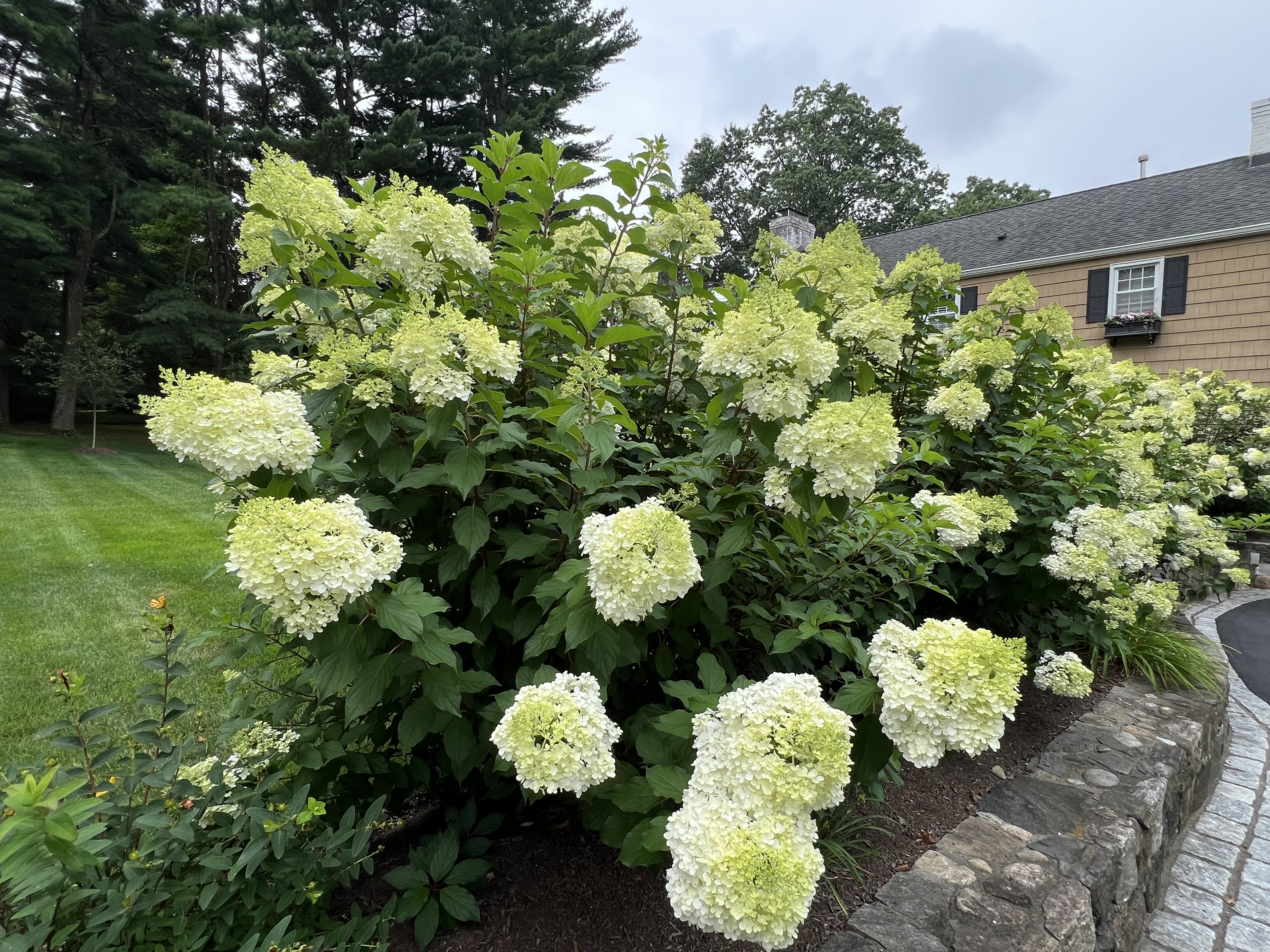
The intentional modification of hydrangea flowers has crossed continents and hydrangea species. Many of the most popular hydrangeas in gardens today are mophead versions developed from the Asian species, Hydrangea macrophylla, or big-leaf hydrangea. You recognize these as the big round flowers that are pink or blue depending on the acidity of the soil, but they are also available in white, pale green, hot pink, and other colors. In fact, there are countless varieties of heavily-modified Asian hydrangea species on the market, including the popular tree form “Pee Gee” and the enormous conical flowers of “Limelight,” both modifications of the Asian Hydrangea paniculata.
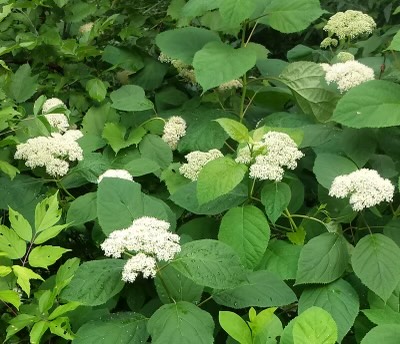
Native North American species have been similarly modified to create fancy flowers. Hydrangea arborescens, or Smooth Hydrangea, is native to forests from New York to Ohio, and south from Oklahoma to Georgia. In the wild, it has flat-topped clusters of tiny white fertile flowers with occasional mutations adding a few sterile flowers scattered around the outer ring.
Natural form of the native Hydrangea arborescens
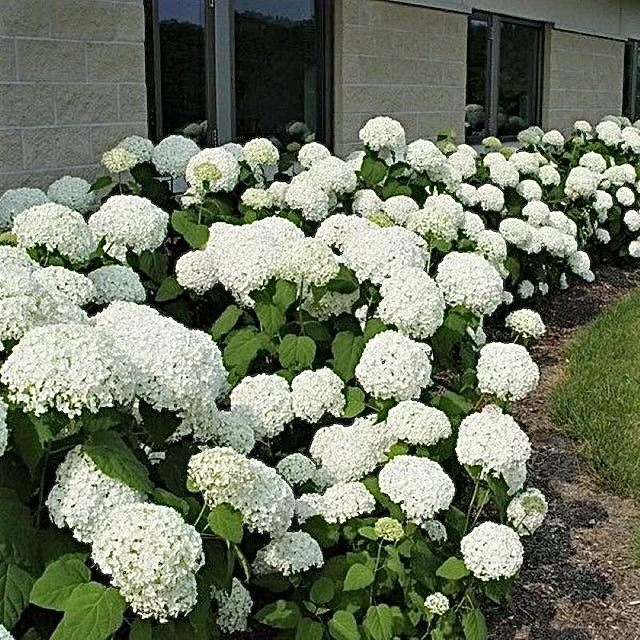
To make its flowers more appealing to humans, growers selected the mutated flowers and modified them dramatically to increase their number and size, eventually eliminating the fertile flowers altogether. The result was a plant with enormous mophead flowers that they labelled ‘Annabelle’ hydrangea, and introduced to the American market in the 1960’s. Since then, many other named varieties (‘Snowball,’ ‘Incrediball,’ ‘Invincibelle,’ etc.) have been developed to appeal to gardeners. Unfortunately, these showy mophead forms offer nothing to bees because the fertile flowers have been manipulated out of existence.
‘Annabelle’ and other cultivars of Smooth Hydrangea have made this native plant useless for bees. Photo from nursery advertisement
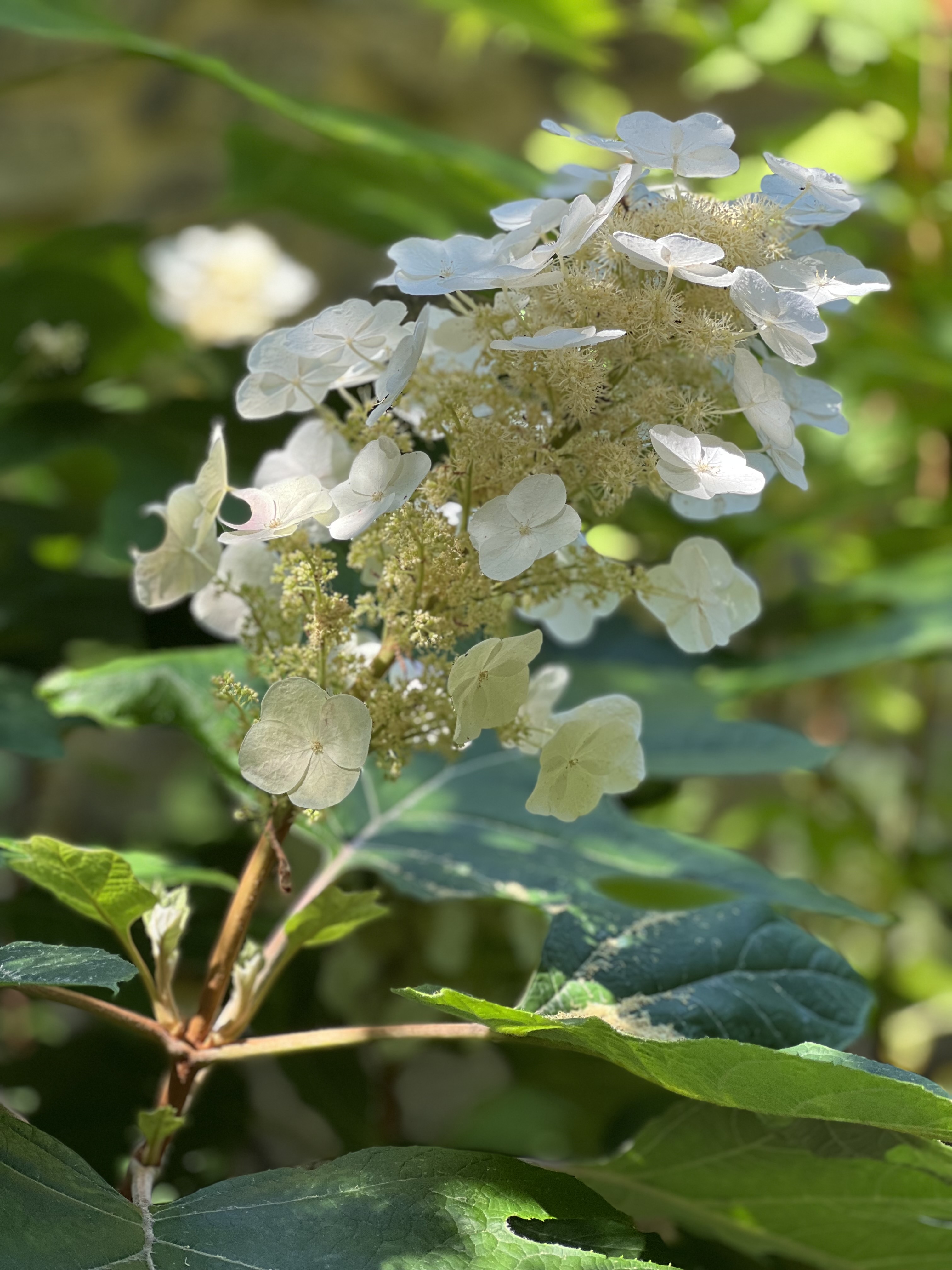
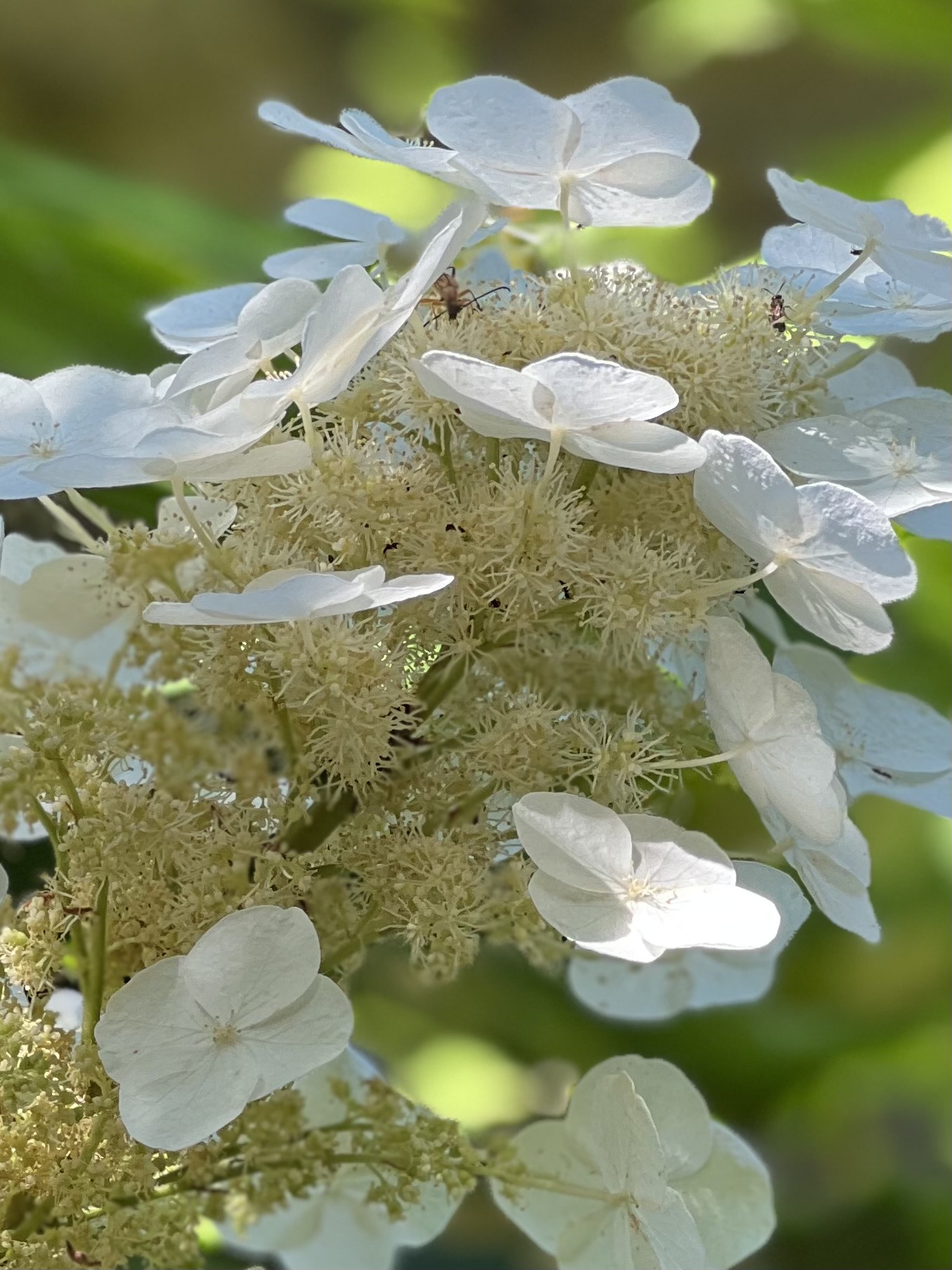
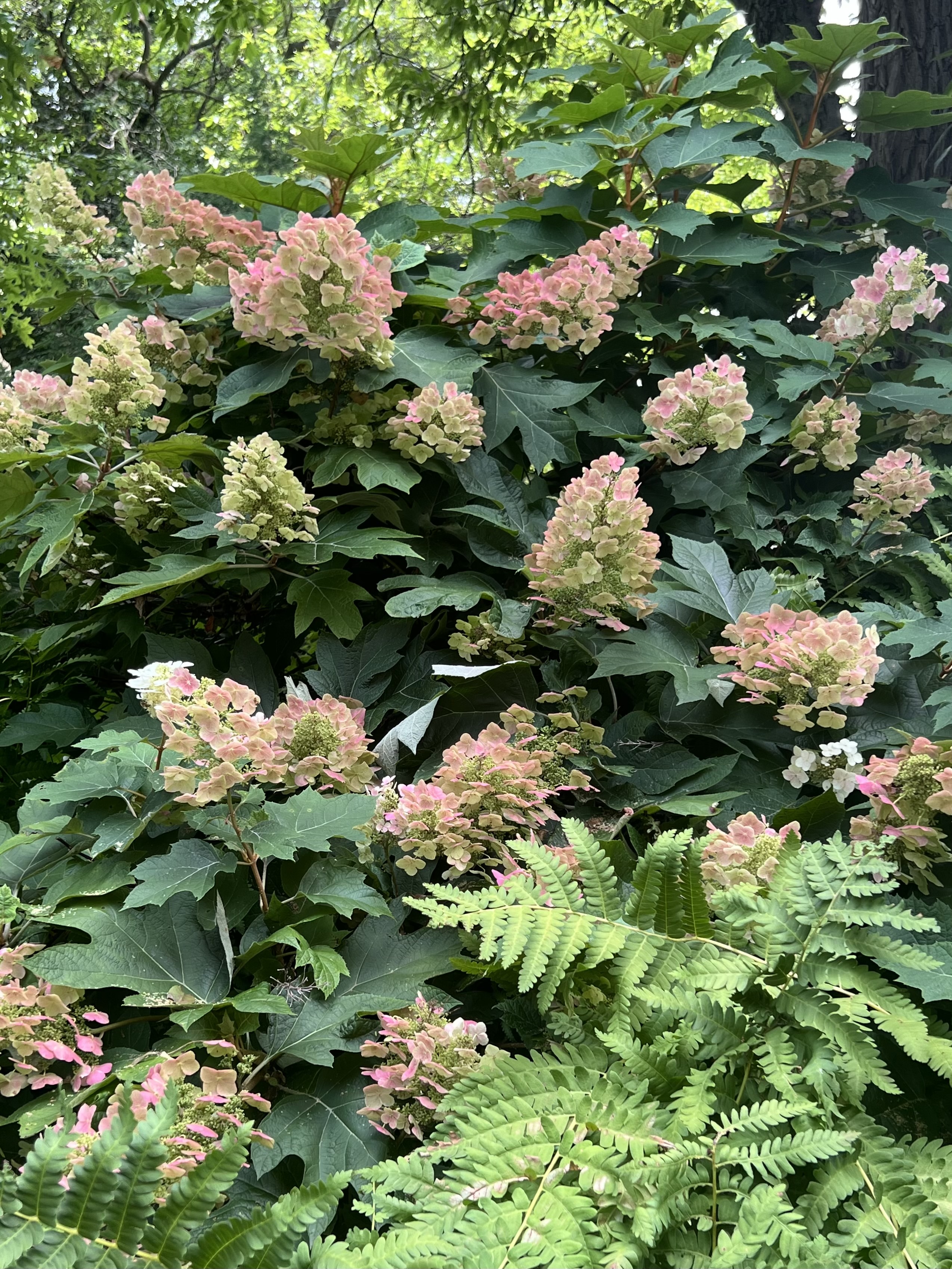
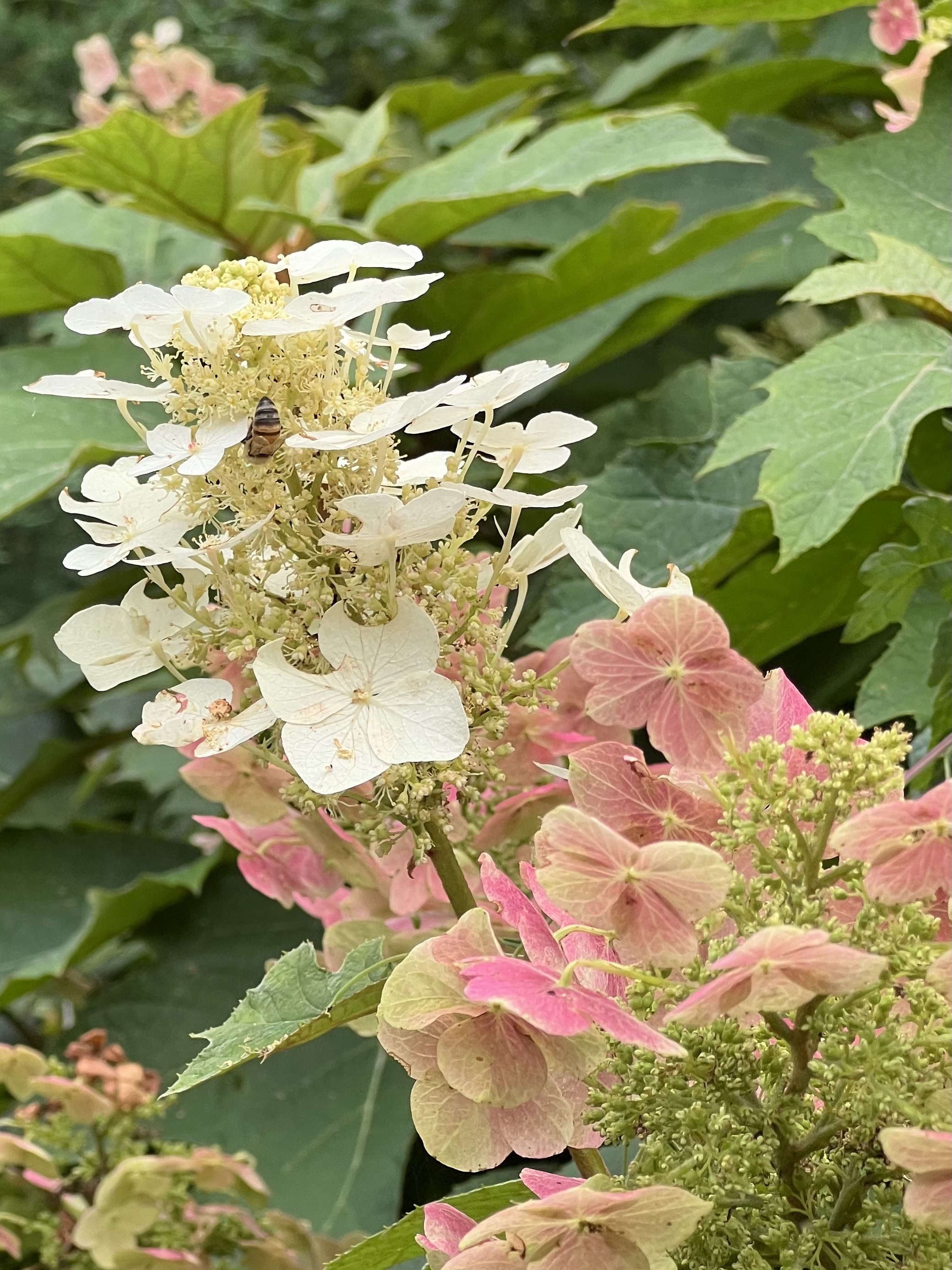
Even our excellent native shrub, Oakleaf Hydrangea (Hydrangea quercifolia), has been targeted for flower modifications by growers. Oakleaf Hydrangea naturally has large conical flowers that emerge white and gradually turn pink. They are beautiful and loaded with fertile flowers that are an important source of nectar and pollen for bees. (For more information on Oakleaf Hydrangea, click here.)
Oakleaf Hydrangea is native to the Southeastern US, but grows well in gardens throughout the mid-Atlantic region
Conical flowers of Oakleaf Hydrangea are beloved by bees
Apparently not satisfied with an already excellent and garden-worthy native plant, the nursery industry has introduced cultivars of Oakleaf Hydrangea with flowers so altered that they have no remaining value to bees.
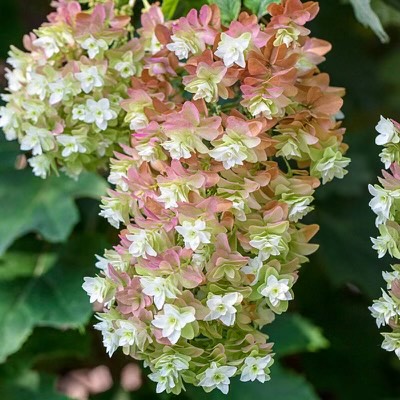
A double-flowered version of native Oakleaf Hydrangea has eliminated fertile flowers completely
Dense conical flowers with no interior fertile flowers on this Asian hydrangea do not support bees
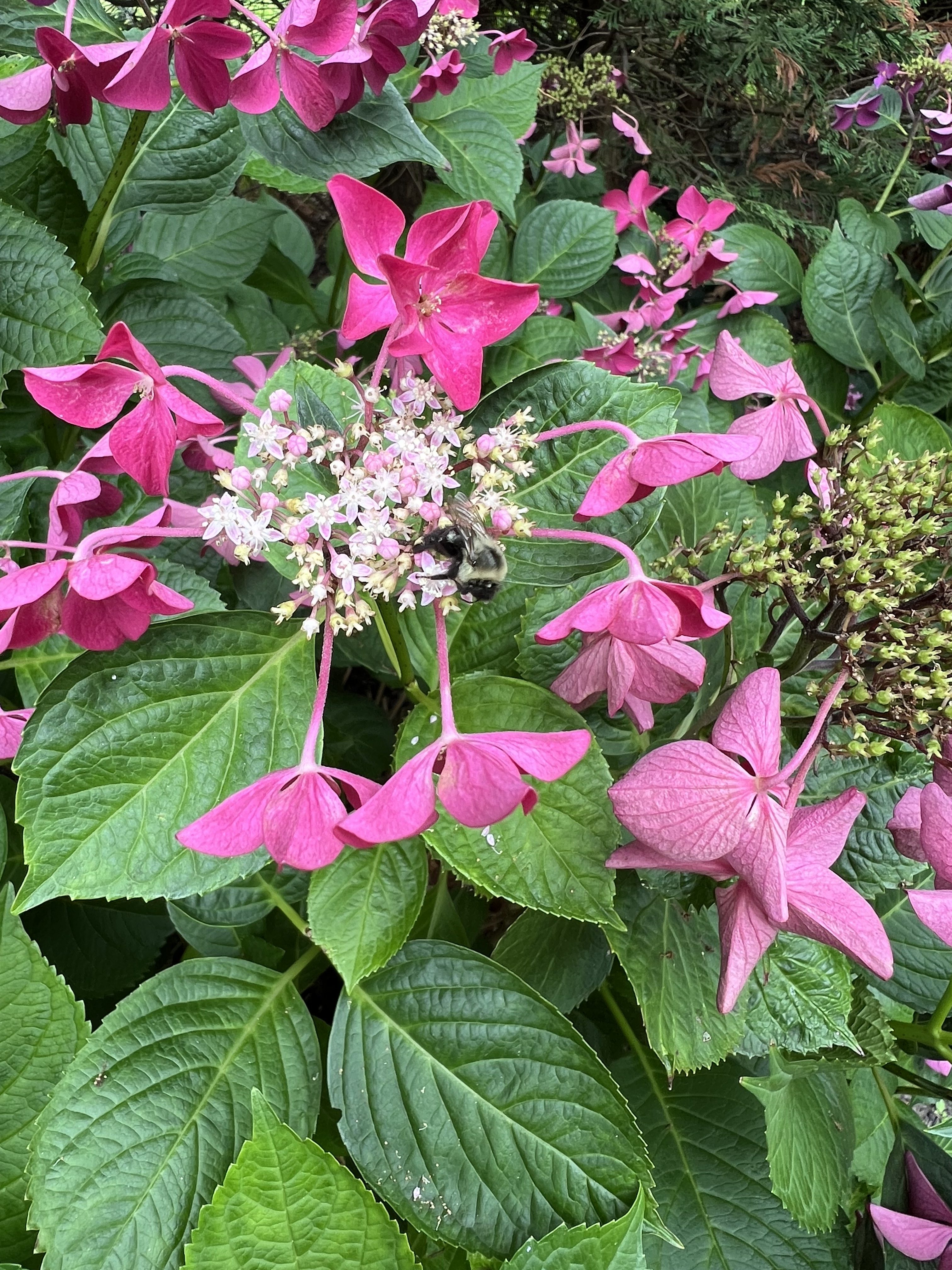
Open conical flowers with large clusters of fertile flowers inside, like natural Oakleaf Hydrangea flowers, are a feast for bumblebees and other pollinators. And lace-cap flowers, whether Asian or native, because they are formed with large clusters of fertile flowers in the center, attract many species of bees.
An Asian lace-cap hydrangea visited by bumblebees
In a recent 5-year trial at the Mt. Cuba Center in Delaware, 29 cultivars of the native Smooth Hydrangea, including 16 mophead and 13 lace-cap varieties, were evaluated for garden appeal and performance. https://mtcubacenter.org/lacecap-hydrangeas-take-top-marks/ Investigators also monitored each of the plants for pollinator visits, extrapolating the results over the growing season. They found that lace-cap flowers were visited by pollinators at 3½ times the rate of mophead flowers. Although they did not report on the duration of visits, they did observe that bees approached the mophead flowers, but apparently did not often find reason to stay.
So, if we care about bees, flower shape matters!
For gardeners who love hydrangeas and also care about bees, the best bet is to include lace-cap and open conical flower forms with plenty of fertile flowers in your garden. Native Oakleaf Hydrangeas in natural form and native Smooth Hydrangeas in lace-cap form (like ‘Haas’ Halo’) are widely available at nurseries. And if you love the bright colors and playful shapes of the Asian lace-caps, they are a much better choice than the mopheads.
Go ahead and enjoy your mophead hydrangeas – they are harmless and we all love them. But think about adding a few lace-caps or conical forms with lots of fertile flowers for our bee friends.
You’ll love them, too!
THIS BLOG IS WRITTEN BY CATHY LUDDEN, CONSERVATIONIST AND NATIVE PLANT EDUCATOR; AND BOARD MEMBER, GREENBURGH NATURE CENTER. FOLLOW CATHY ON INSTAGRAM FOR MORE PHOTOS AND GARDENING TIPS@CATHYLUDDEN.
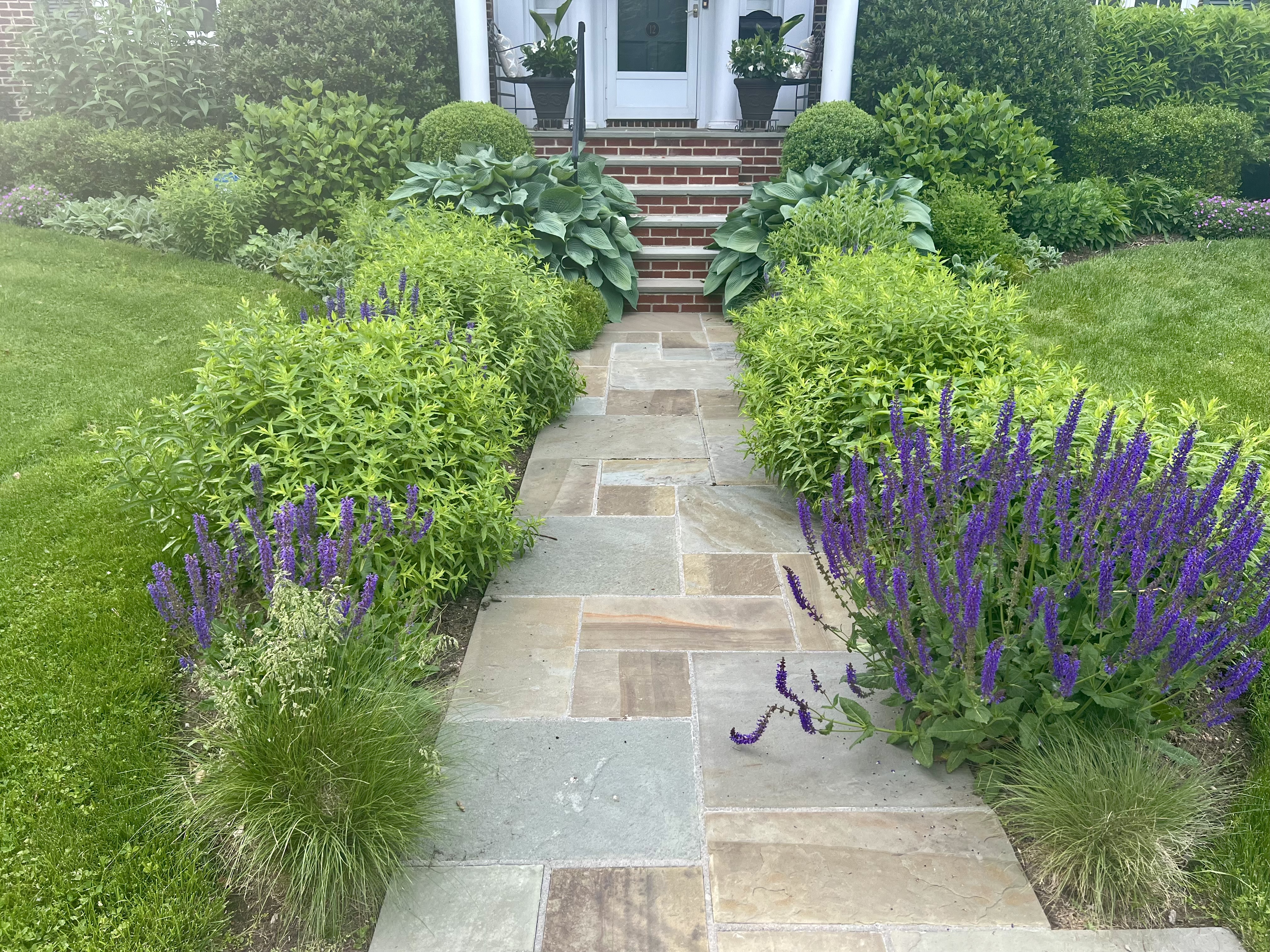
A paved walkway to the front door is one of the most common features of suburban residential landscapes. And it’s important! It is a visitor’s first impression of your home and a major element of “curb appeal.” Landscape design professionals recommend planting your walkway to welcome visitors and visually direct them to the correct entrance while giving them something interesting and beautiful to see along the way.
A well-planted entry walk guides visitors to the front door.
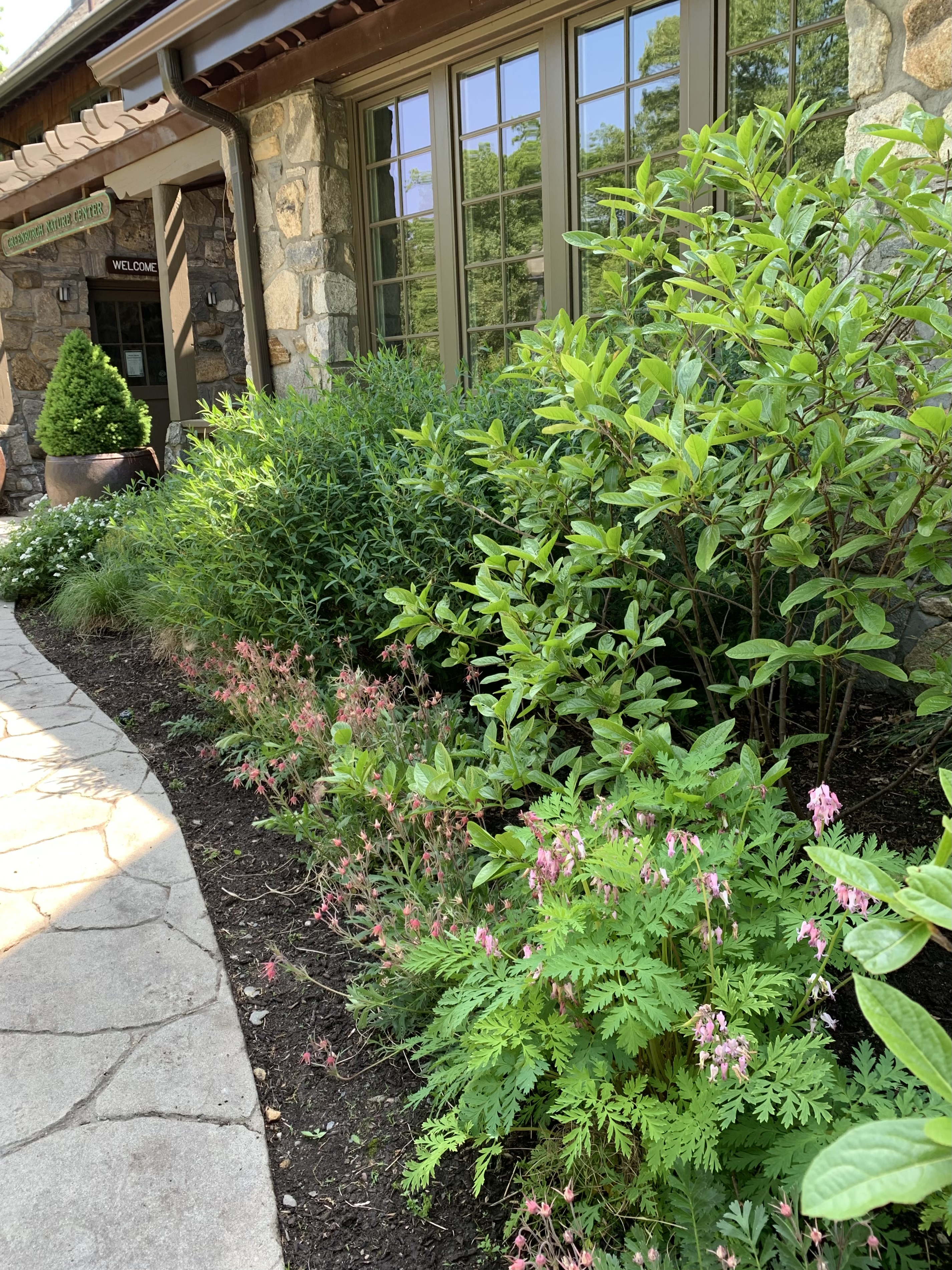
The entry path to the Greenburgh Nature Center in spring.
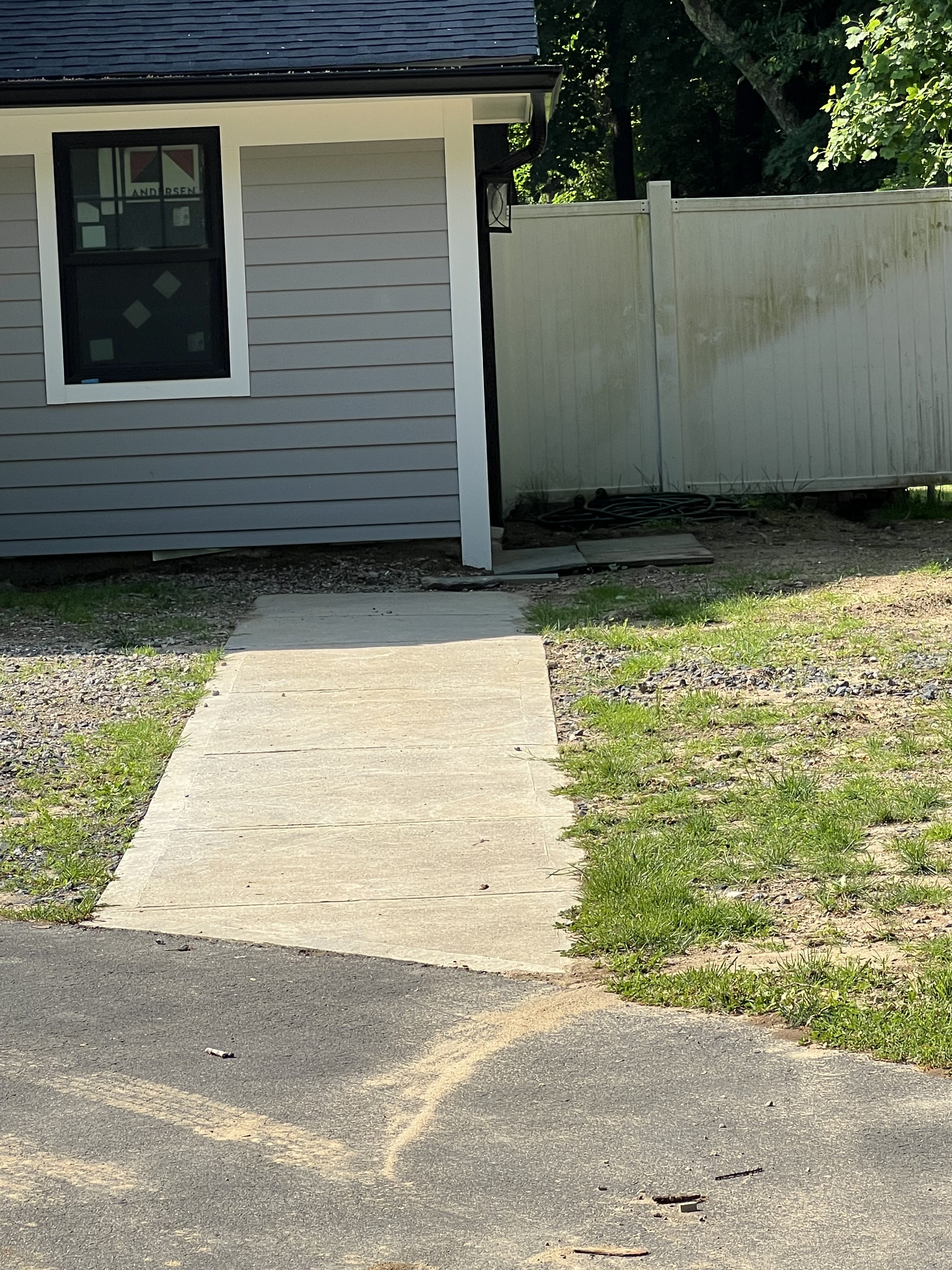
But a paved walkway presents multiple challenges for landscaping. The process of paving, whether with stone, concrete, brick, or asphalt, often damages the adjacent soil, leaving it compacted, dry, and rocky with bits of concrete and masonry that can significantly alter soil pH and create poor planting conditions.
New construction of paved areas can leave depleted soil.
Paved surfaces are also warmer in summer and colder in winter than the surrounding soil. Pavement reflects summer heat onto adjacent areas and can hold that heat long after sunset. Frozen pavement, on the other hand, can be even colder than surrounding air and soil temperatures, and snow cleared from walkways often includes salt or ice-melting products damaging to plants. With these extremes, it can be challenging to find plants that will look good and survive year-round.
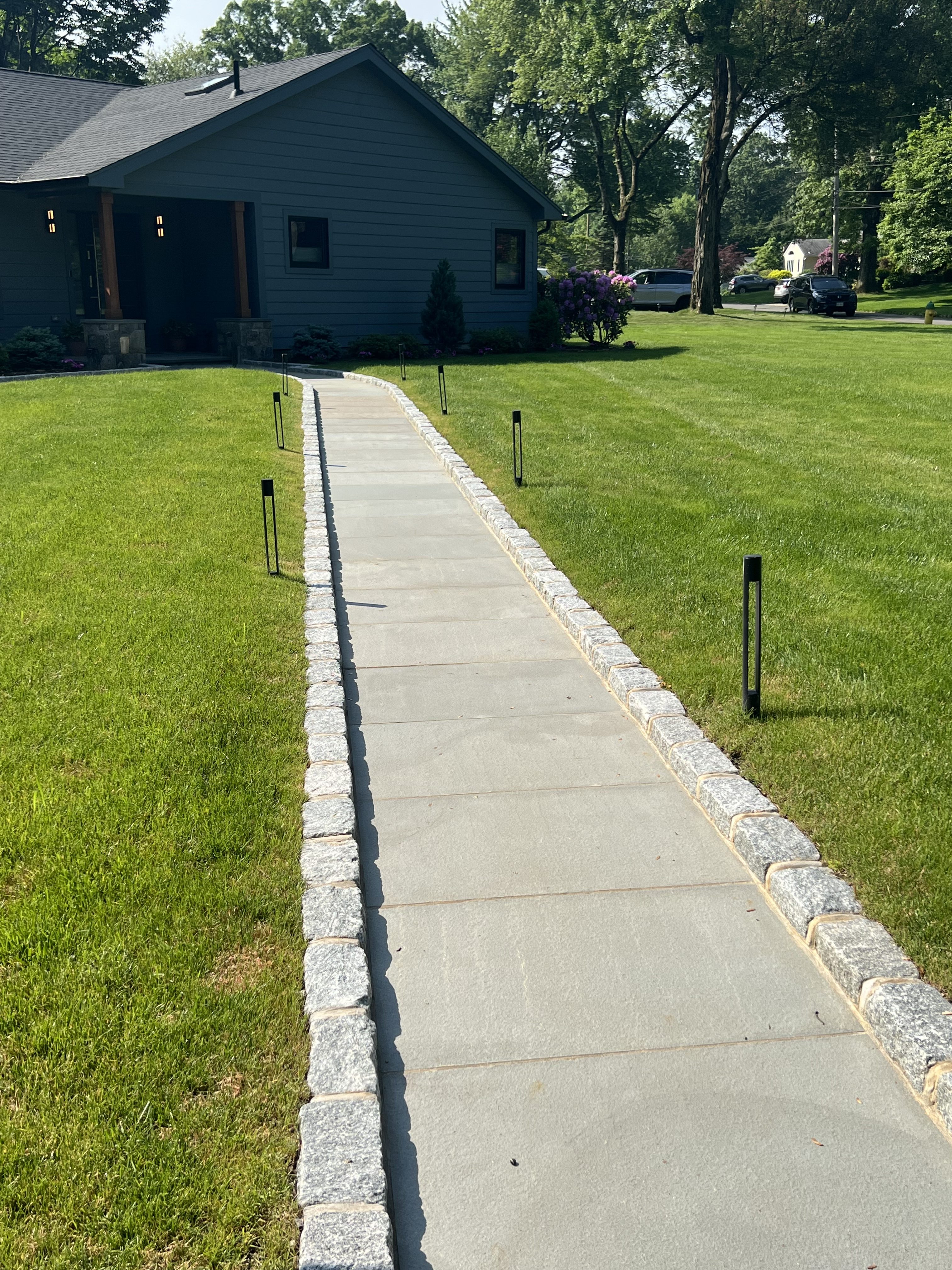
Understandably, many suburban homeowners opt for planting nothing at all along walkways.
The minimalist approach.
Others plant a row of annuals every summer only to watch them wither and die long before fall (New Guinea impatiens anyone?). Most annuals are tropical plants that evolved in the understory of rainforests. The harsh conditions along a paved entry path are a far cry from the rich, wet soil in the shady jungles of equatorial New Guinea!
So, what can you plant along an entry path that will survive tough conditions through summer and winter, and still come back strong in the spring?
Consider plants that evolved in regions with baking hot summers, freezing winters, poor hard packed soil, and weather that can alternate between drought and flood. America’s great prairies and dry meadows are the original habitats of a vast array of hardy native plants. With variations in annual rainfall, soil depth, tree cover, and elevation, an incredible variety of grasses, flowering plants, and hardy shrubs evolved in those challenging landscapes. These native plants are ideal for the conditions so often found on paths from sidewalks and driveways to front doors throughout suburban neighborhoods.
The bonus is that these plants also feed native bees and butterflies and need very little care. Many of them already have been featured in prior posts of this blog. Take a look at these plants as you consider re-designing your entry path, and follow the links below for more information and photos:
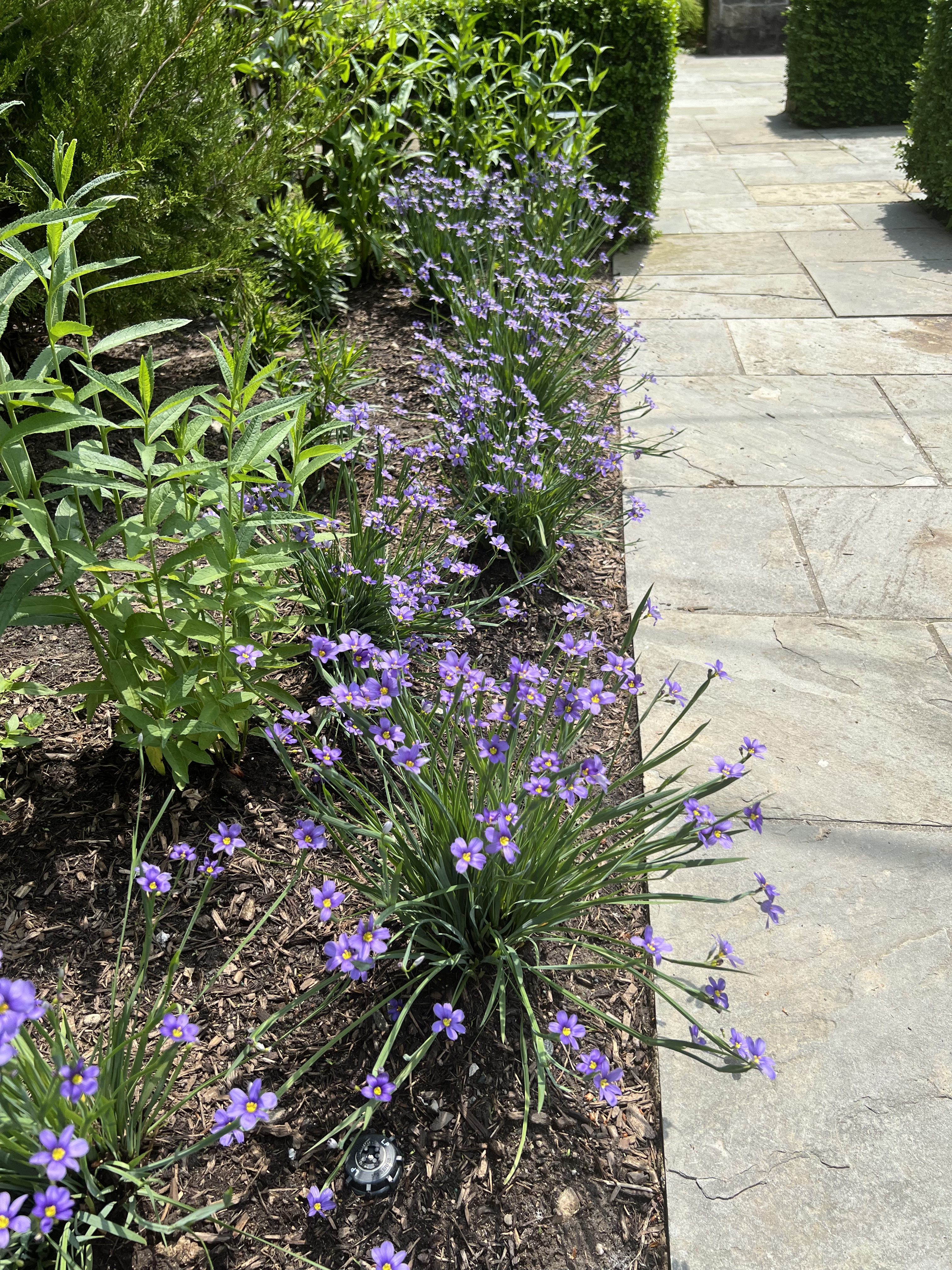
Blue-eyed Grass (Sisyrinchium angustifolium) is a cheerful sight lining a sunny path.
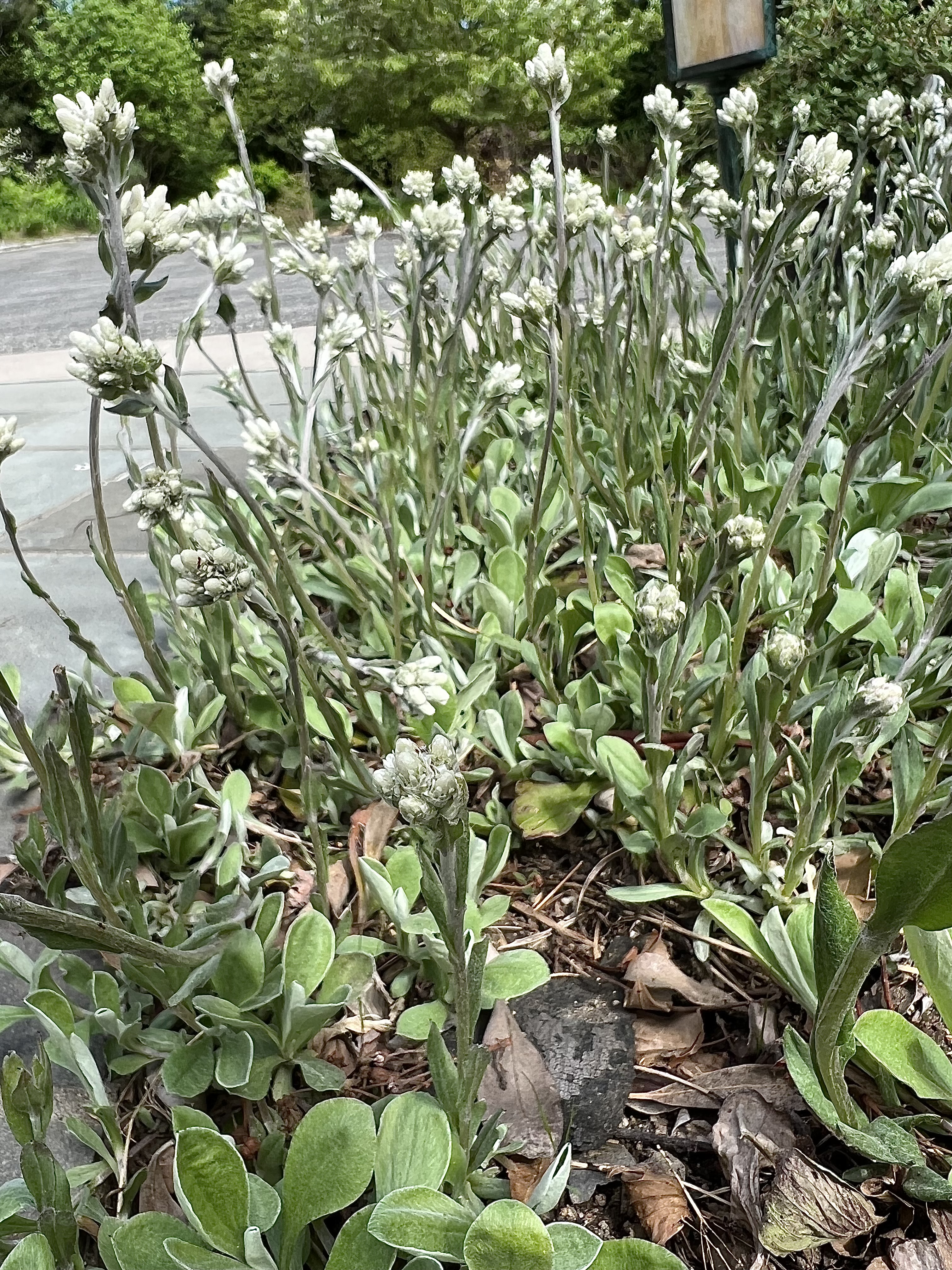
Field Pussy-toes (Antennaria neglecta or A. plantaginifolia) is a grey-green ground cover with adorable cat-paw flowers.
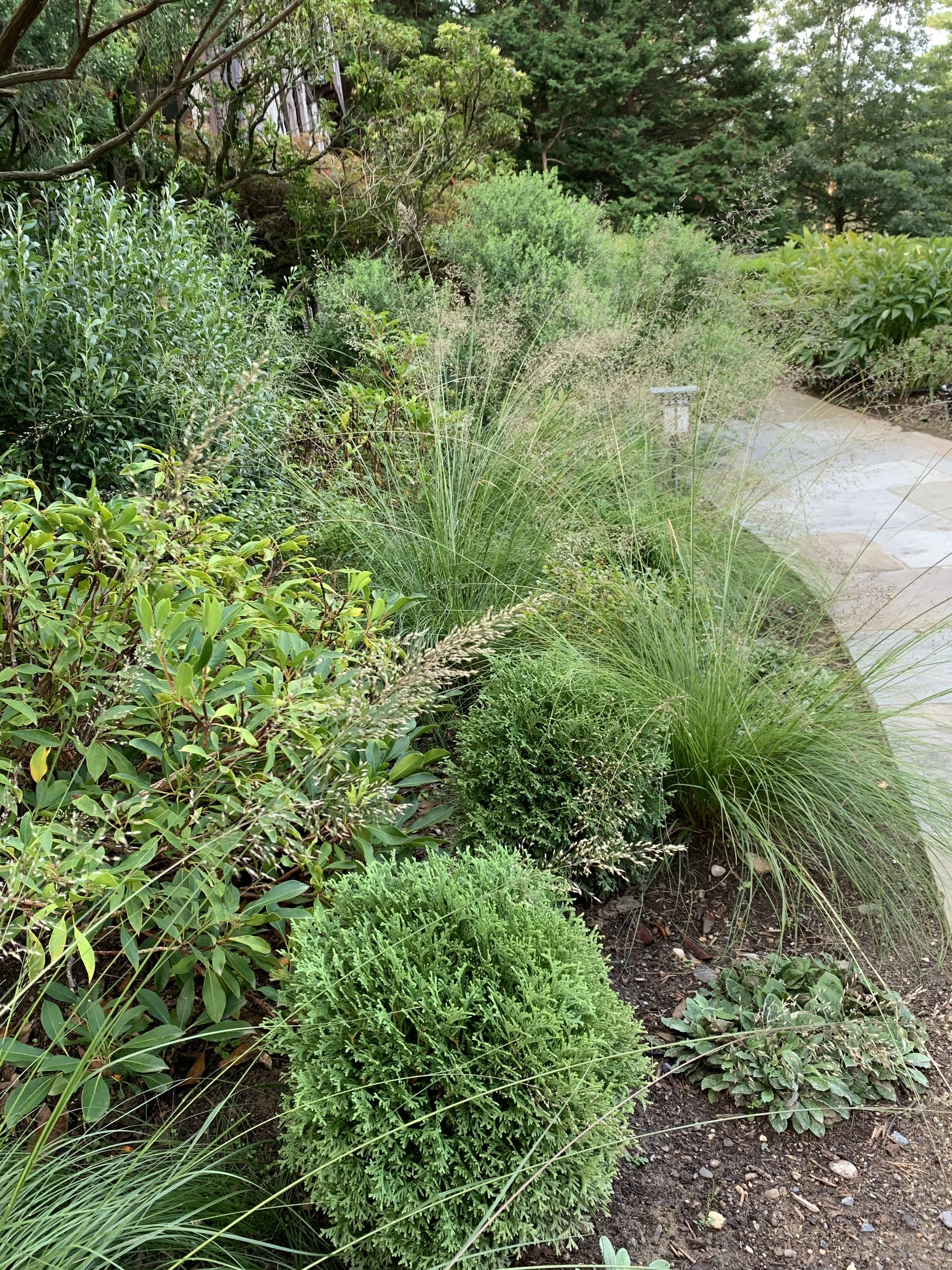
Prairie Dropseed (Sporobolus heterolepsis) is a small ornamental grass with a soft look and a lovely scent.
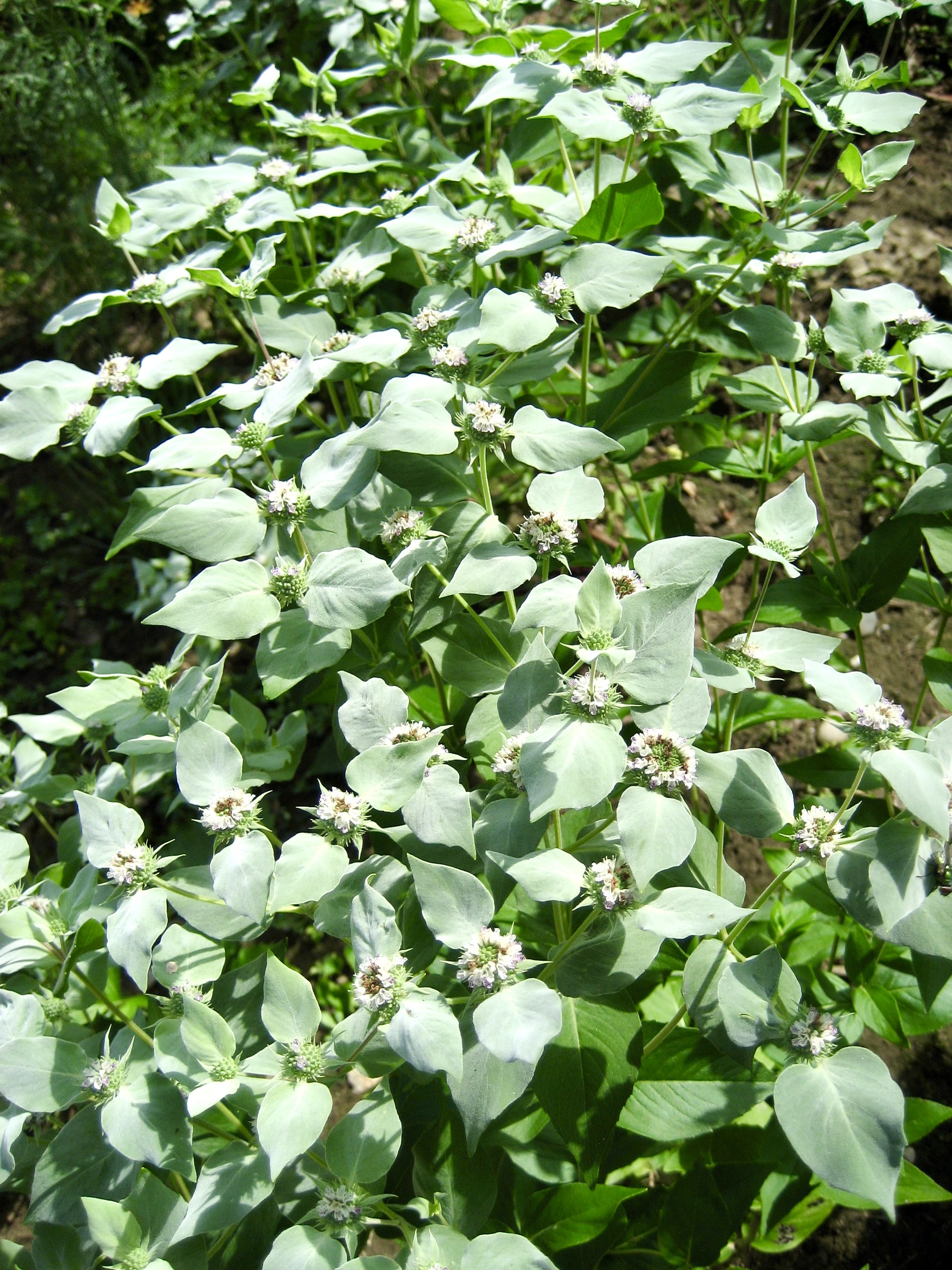
Mountain Mint (Pycnanthemum muticum) grows about 2 ½ feet tall, has flowers that last for months, and smells wonderful.
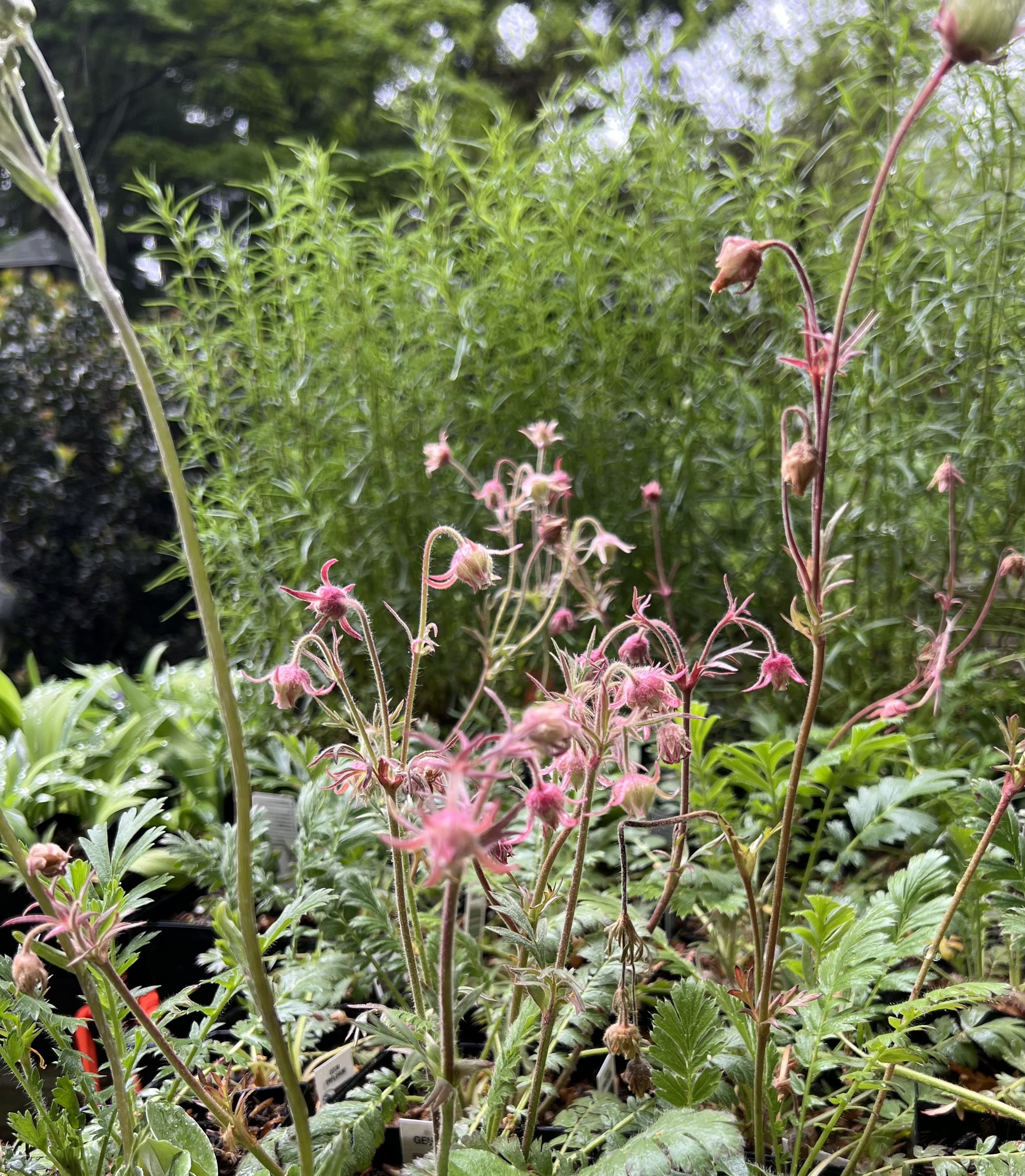
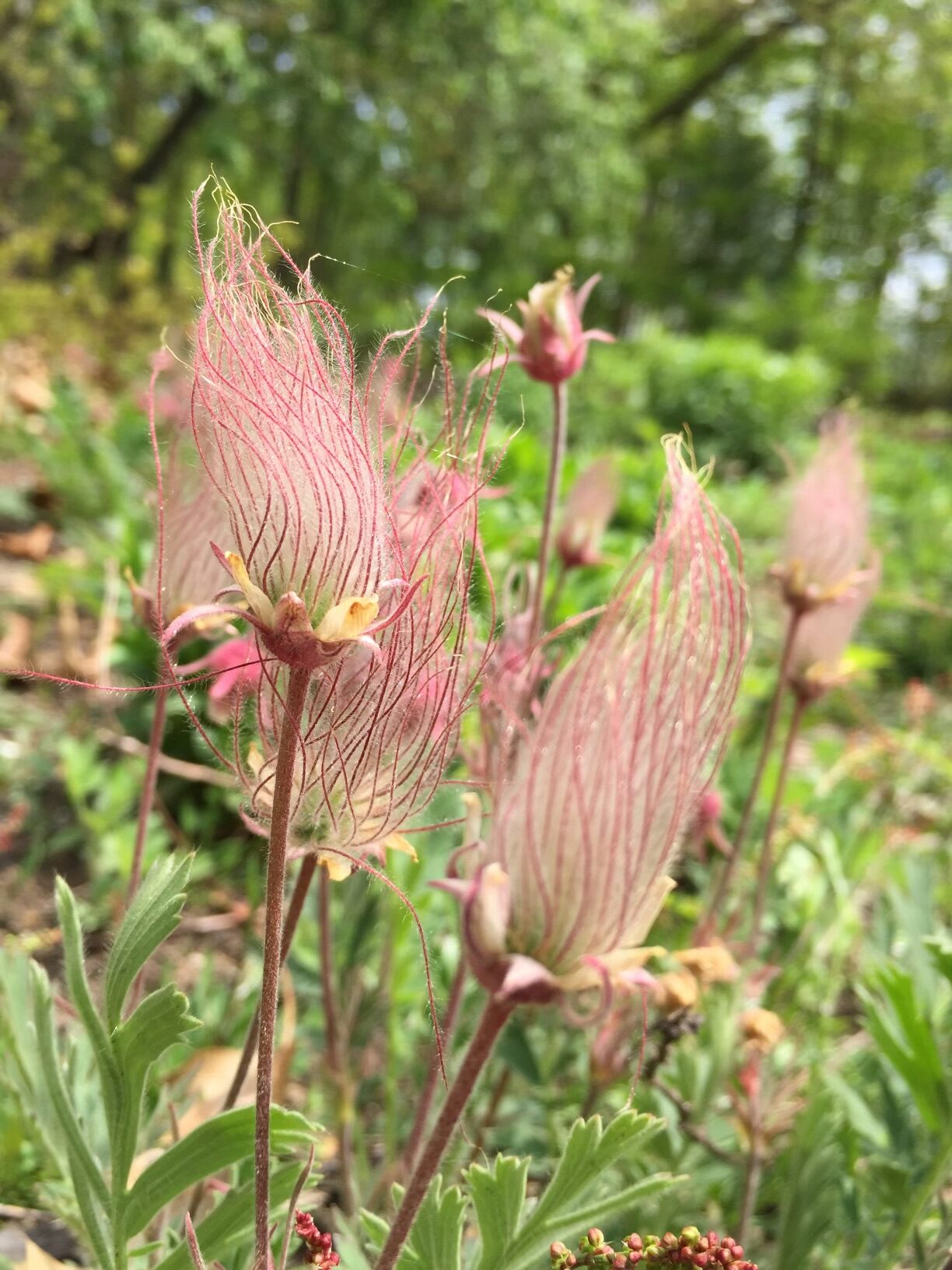
Yet another prairie plant that looks great along a path is Prairie Smoke (Geum trilflorum). Its nodding pink flowers turn into puffs that give it another common name, Old Man’s Whiskers. The foliage stays fresh all summer and turns a lovely burgundy in the fall. It is not bothered by snow cover in the winter or hot dry summers.
Prairie Smoke in stages of spring bloom.
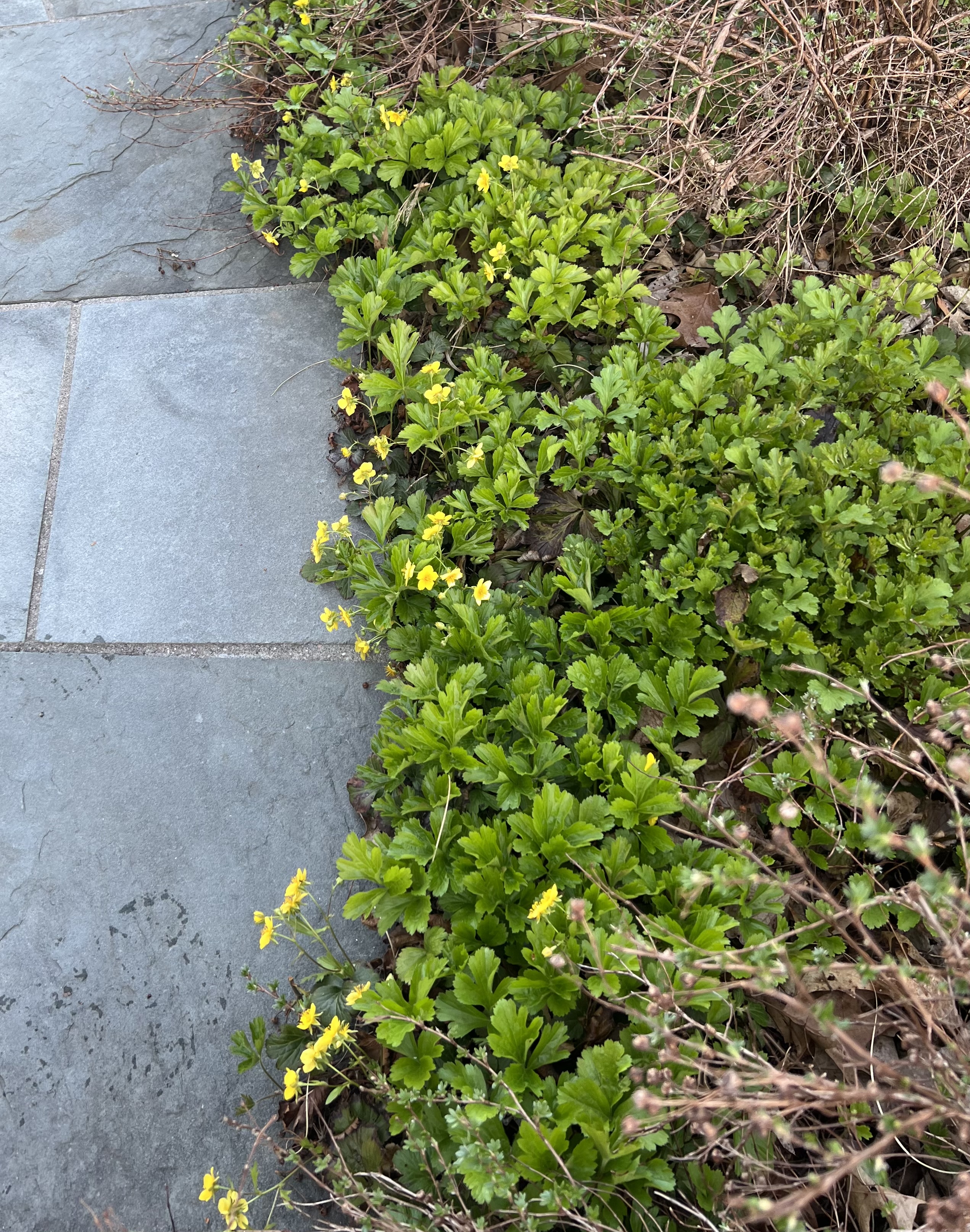
Another reliable low-growing groundcover that can fill in along a path mixed with shrubs and taller perennials is Barren Strawberry (Waldsteinia fragaroides). Blooming with bright yellow buttercup-type flowers for weeks from spring into summer, and semi-evergreen through the winter, it spreads slowly and is exceptionally hardy.
Barren Strawberry (Waldsteinia fragaroides) in March.
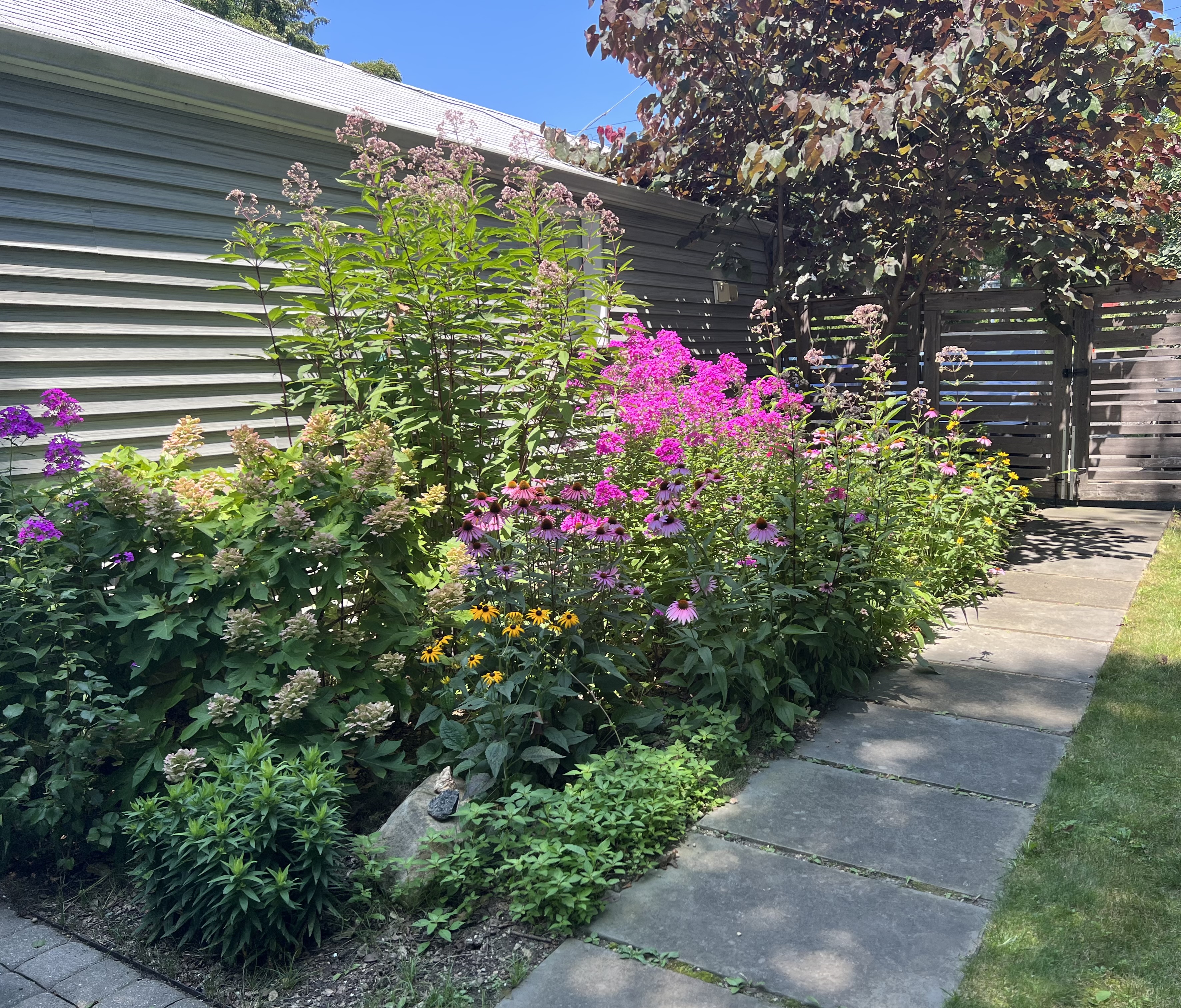
The most attractive pathway gardens include a variety of native perennials, grasses, and shrubs to create four seasons of interest.
A mixed border makes a path interesting.
There are a number of tough native shrubs that mix beautifully with perennials to create a real garden on the way to your front door:
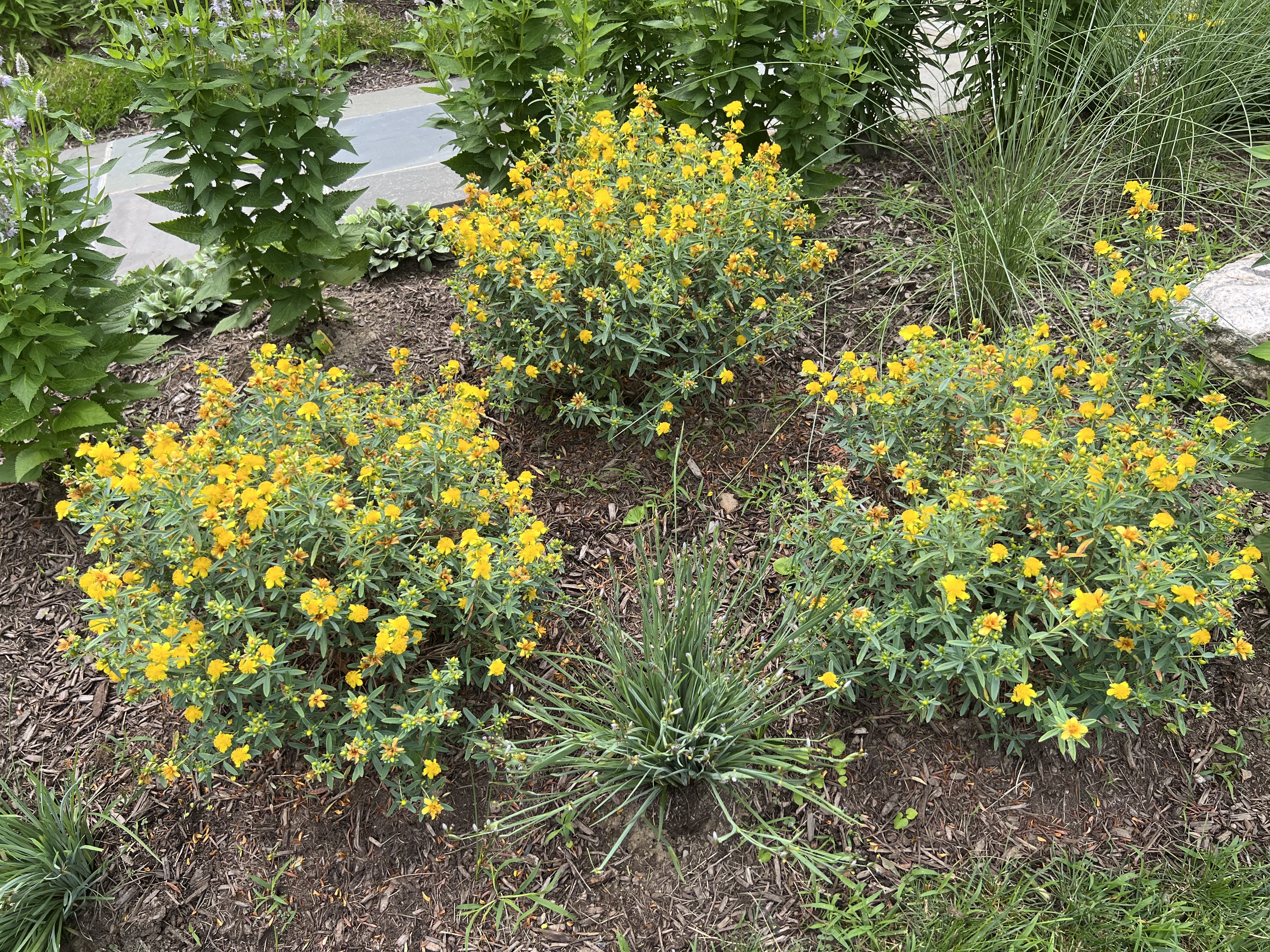
Shrubby St. John’s Wort (Hypericum frondosum, or H. prolificum, or the pictured H. kalmianum) are similar species, but different sizes, and all bloom with bright yellow pom-poms adored by bumblebees.
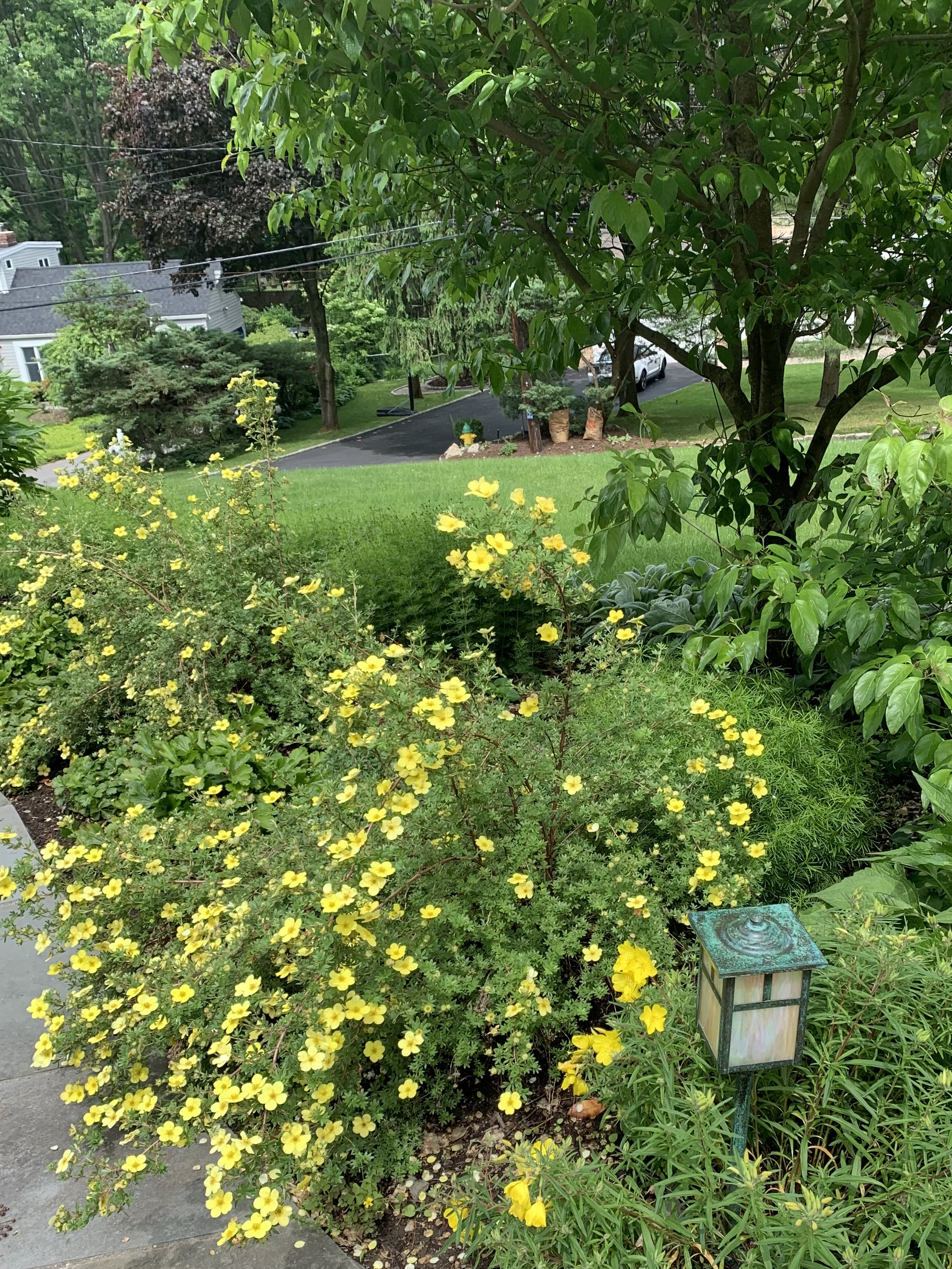
Another great shrub for the entry path is Shrubby Cinquefoil (Potentilla fruticosa). Its flowers may be bright yellow or nearly white, its foliage a soft gray/green, and it blooms all summer long, much to the delight of native pollinators.
An entry path with Potentilla in full bloom.
So, there are many beautiful options for designing a durable planted path to welcome visitors (and nature!) to your front door. Think about pushing your lawn away from the path and giving a bit more space to a native garden that says: “walk this way!”
THIS BLOG IS WRITTEN BY CATHY LUDDEN, CONSERVATIONIST AND NATIVE PLANT EDUCATOR; AND BOARD MEMBER, GREENBURGH NATURE CENTER. FOLLOW CATHY ON INSTAGRAM FOR MORE PHOTOS AND GARDENING TIPS@CATHYLUDDEN.
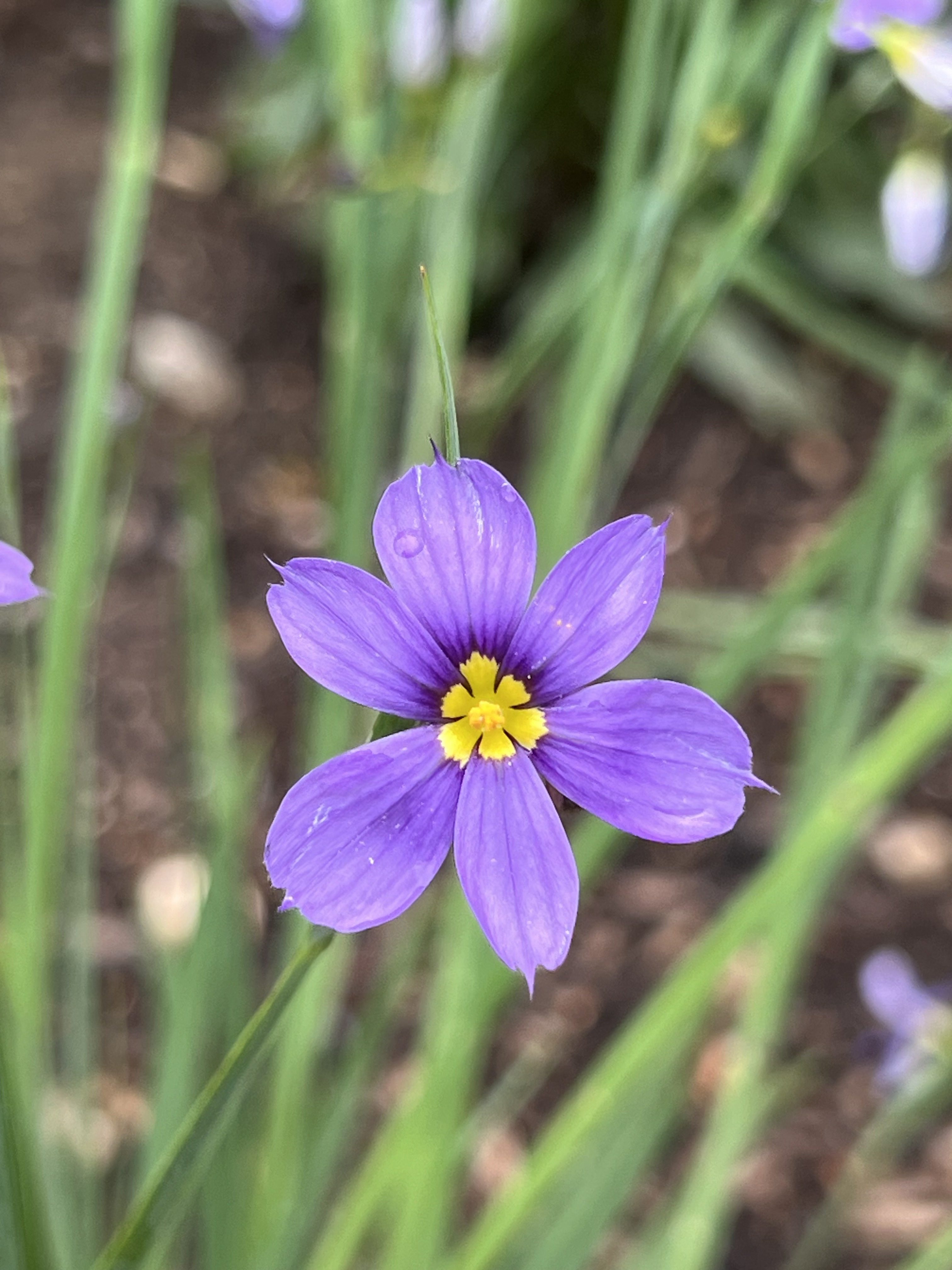
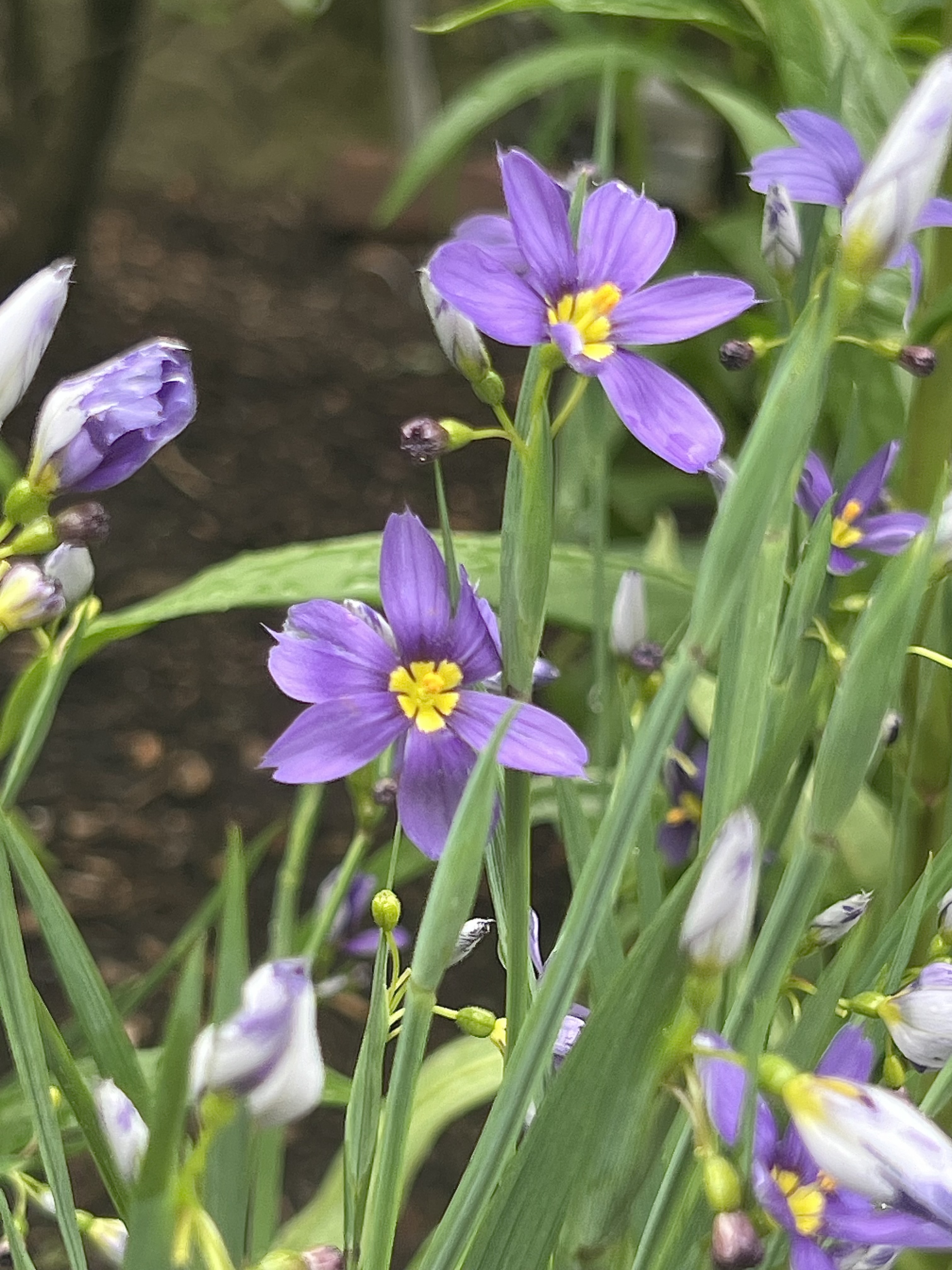
When the sun rises high enough to warm Blue-eyed Grass (Sisyrinchium angustifolium), its violet-blue flowers open wide to soak up the rays. A passing rain shower or dark clouds, however, will cause this sun-worshipper to fold up tight and hide until the sun reappears. From early May through June, and occasionally even later, the flowers of Blue-eyed Grass welcome the sun like kids on spring break.
Blue-eyed Grass basking in the sunshine.
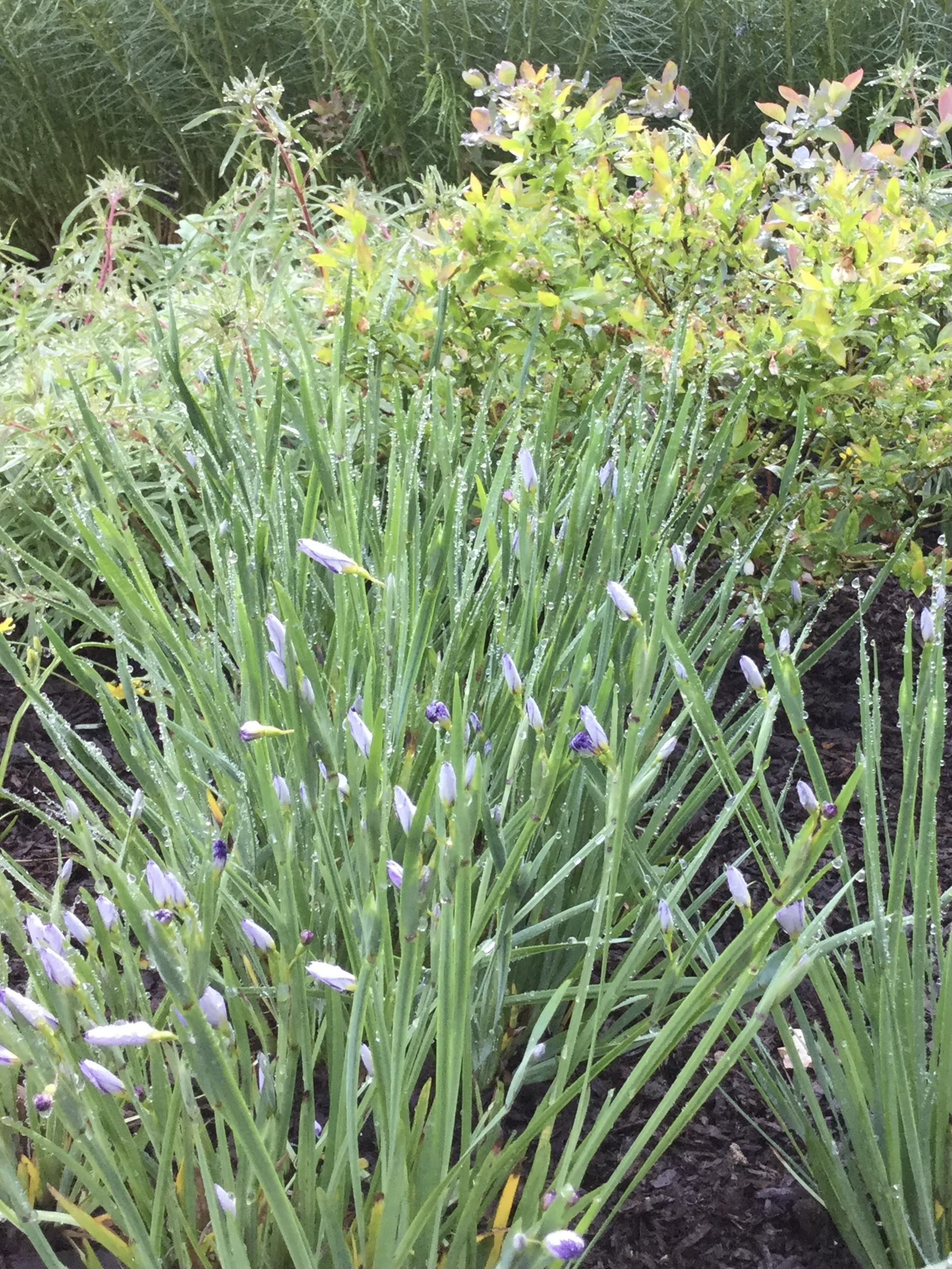
Flowers curled up tight waiting for the sun after a rain.
Despite its common name, Blue-eyed Grass is not a grass at all. It’s actually in the iris family. The leaves are blade-shaped, like miniaturized versions of the leaves of bearded iris. And the flowers emerge from slits in the sides of the leaves, as they do in other irises.
Flowers unfold from inside the leaves.
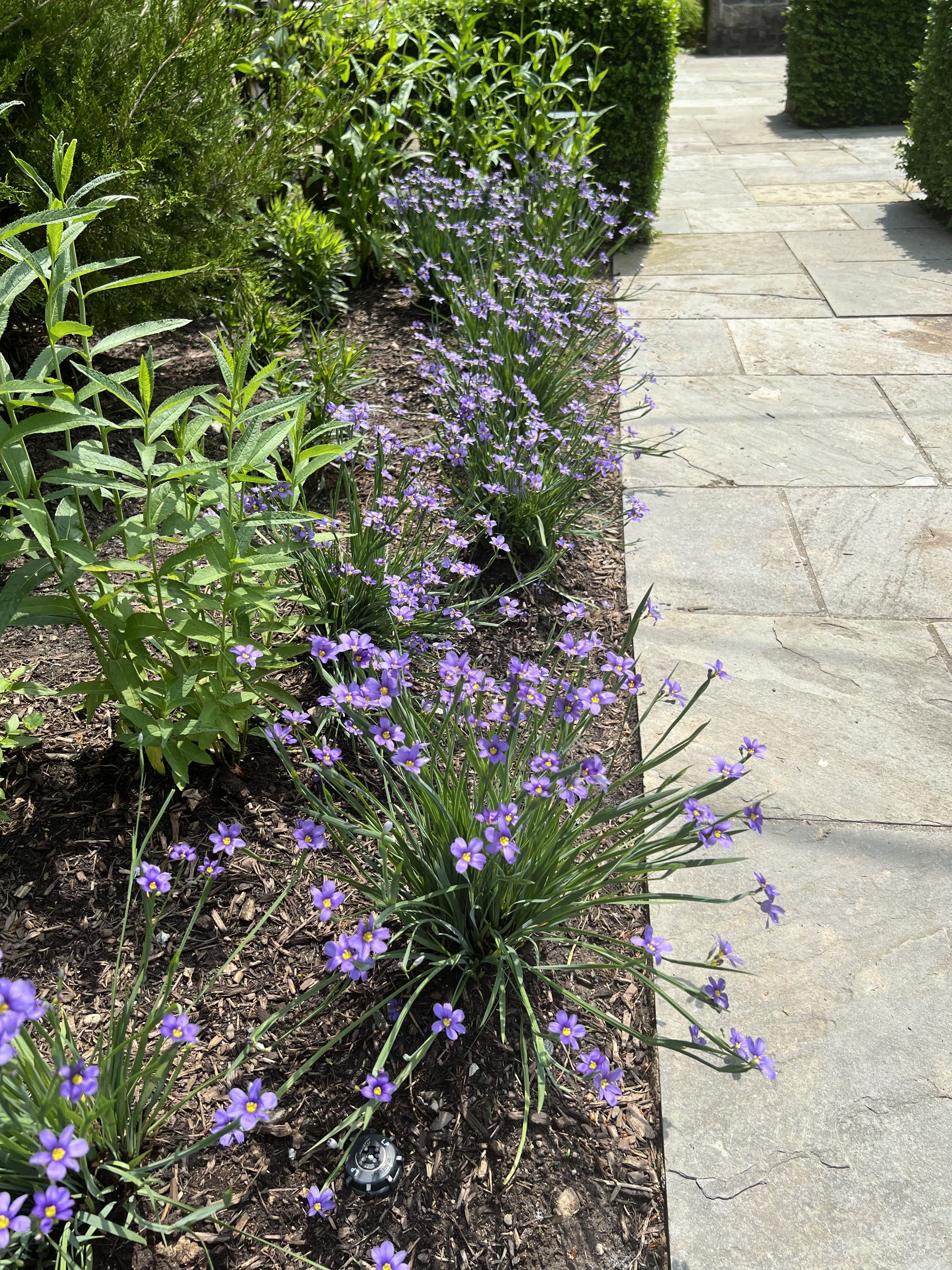
The plant is only 6 to 12 inches tall, and the flowers are less than an inch across with cheery yellow centers. The small flowers can create a big effect if they are grouped along a walkway or at the front of a garden. They are a great choice for rock gardens, and for lining the edge of a paved path where the soil tends to be thin, poor, and rocky. Blue-eyed grass actually prefers poor soil and will suffer in rich, organic soil. Regular moisture is ideal as long as the soil is well drained — so a path to the front door is the perfect spot!
Blue-eyed Grass along a front entry walk.
Blue-eyed Grass is native to most of Eastern North America, from Newfoundland to Minnesota and south to Texas and Florida. Its typical habitat is damp meadows or grassy riverside areas where there is moisture, but sandy or rocky soil that prevents water from settling around the growing crown or roots. Most growers advise against mulching around the plant’s crown to prevent rotting. As long as you avoid that, the plant is virtually care free.
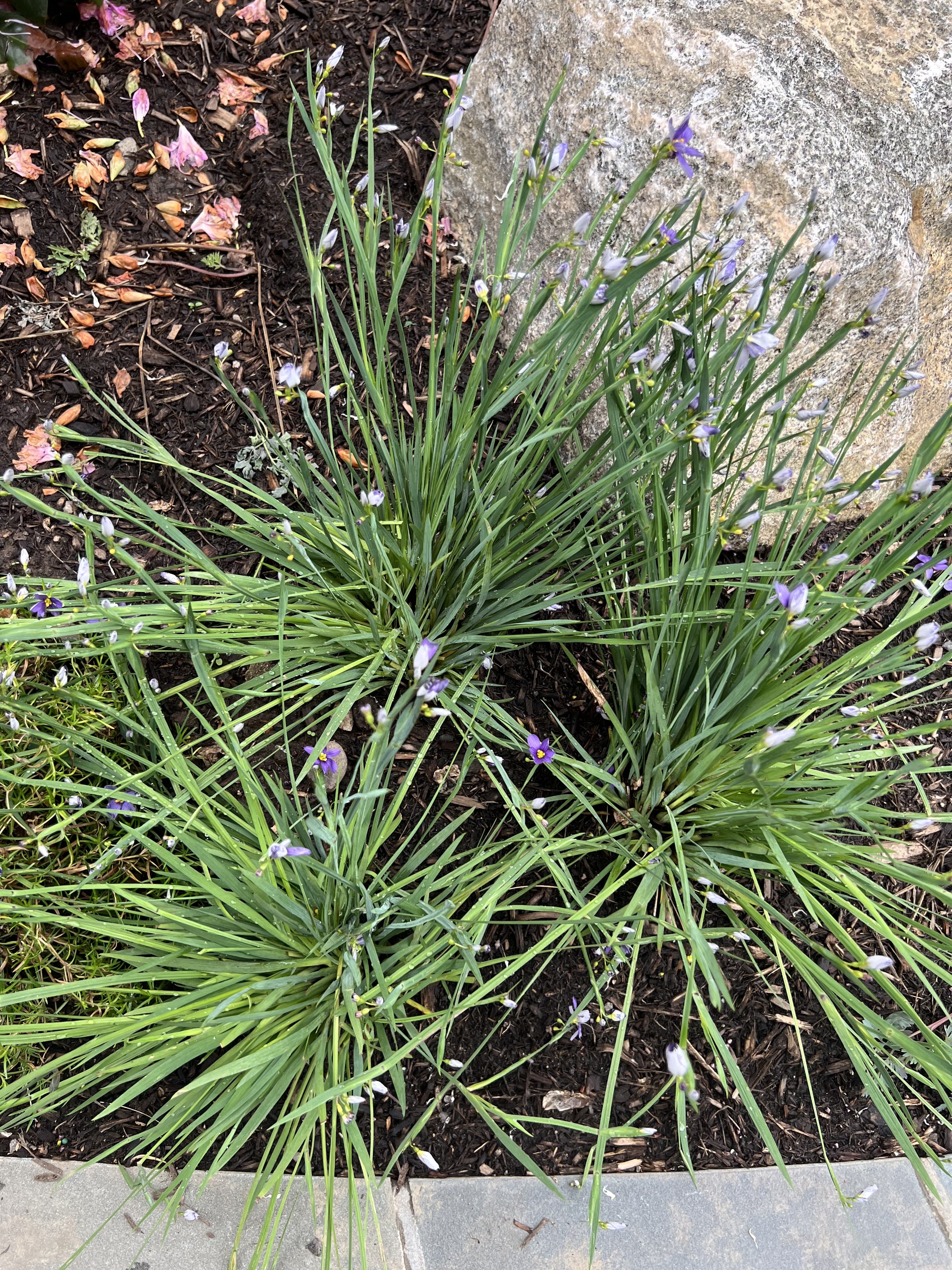
Blue-eyed Grass continues looking good even after the bloom season ends. The grassy clumps blend well with other small perennials or ground covers and stay fresh through fall. Hardy in zones 3 to 9, the foliage is semi-evergreen except in the coldest zones, and it is does not seem to mind being buried by snow shoveled off of walkways.
The grass-like texture of Sisyrinchium looks great all year.
Blue-eyed Grass is increasingly popular with suburban gardeners, so it is fairly easy to find at nurseries. A cultivar called ‘Lucerne’ was developed in Switzerland by horticulturists working with the North American native plant. Its flowers are bit bigger and darker blue than the straight species (all of the photos above are of ‘Lucerne’). Blue-eyed Grass is not attractive to deer or other mammals, but it does attract pollinators, so it’s a great addition to pollinator gardens. And the seed pods are favored by cardinals, house finches, and other songbirds late in the season.
Individual plants of Blue-eyed Grass are not long-lived, but they do seed themselves near the mother plant, so colonies can continue indefinitely. If re-seeding is not desired, dead-heading the flowers after blooming will prevent that. In fact, the whole plant can be sheared in mid summer to keep it tidy after blooming. Blue-eyed Grass grows from a small rhizome, but will also spread itself by sending out off-sets from the roots of the parent plant. If older plants seem to bloom less than before, they can be divided by digging up the plant and carefully teasing apart the roots to create new plants as well as refreshing the old one.
Though Blue-eyed Grass can be grown fairly easily from seed, it will take a few years to bloom. Container specimens can be planted in spring or early fall to give the roots time to develop. Gallon-sized or larger container plants will put on a good show their first season.
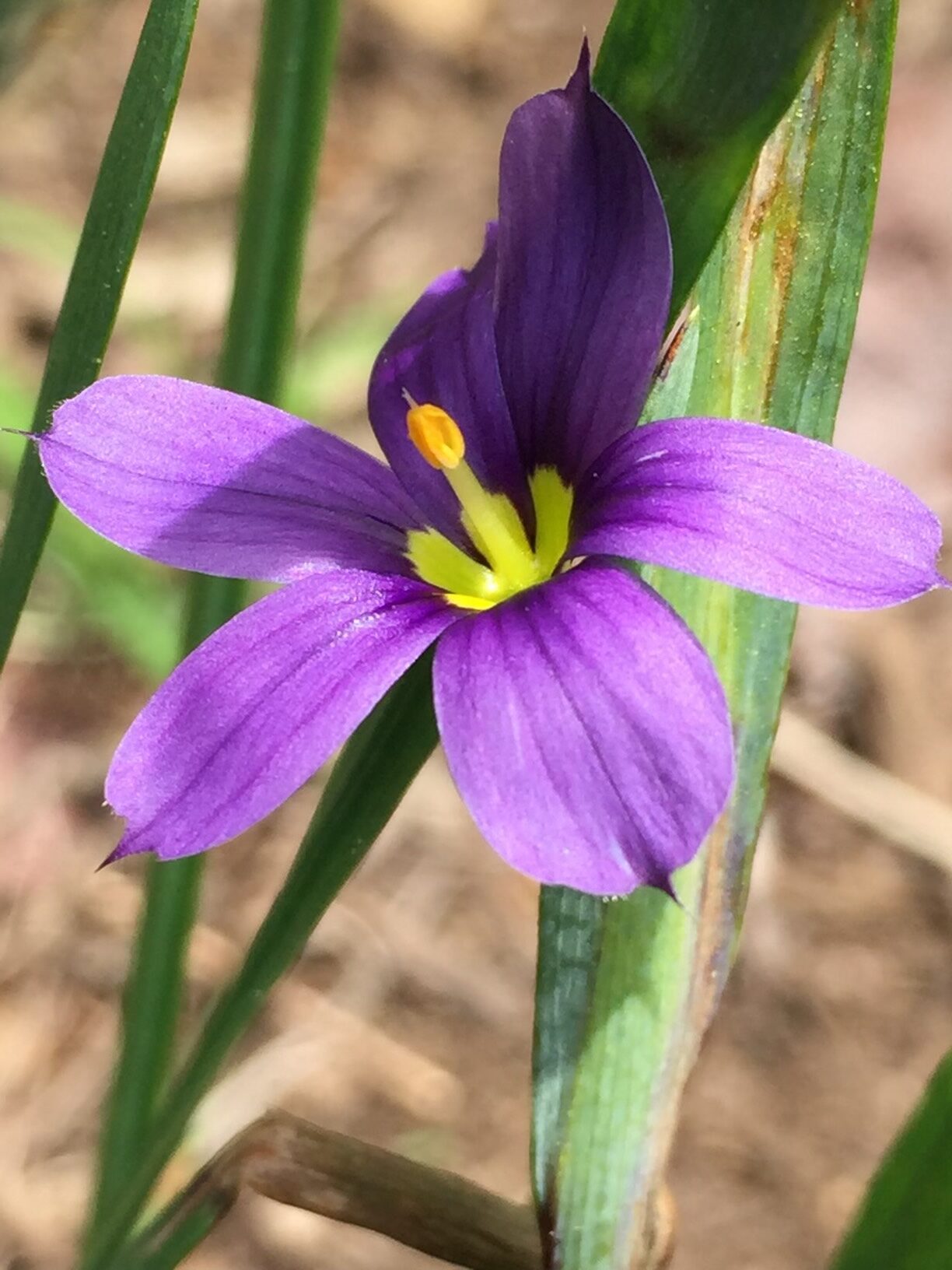
Sisyrinchium angustifolium straight species in the Meadow at the Greenburgh Nature Center. Photo: Travis Brady
It’s a bit surprising that we don’t see this wonderful native plant more often in suburban yards. Instead of planting annuals that must be replaced every year, why not choose this native perennial for your front walk or along the edge of your patio?
If you do, blue skies will have Blue-eyed Grass shining for you!
THIS BLOG IS WRITTEN BY CATHY LUDDEN, CONSERVATIONIST AND NATIVE PLANT EDUCATOR; AND BOARD MEMBER, GREENBURGH NATURE CENTER. FOLLOW CATHY ON INSTAGRAM FOR MORE PHOTOS AND GARDENING TIPS@CATHYLUDDEN.
Flowers are blooming, birds are chirping, insects are buzzing, and all around us nature is waking up to spring.
And miracles are happening: complex and ancient relationships between plants and animals begin again each spring. You can watch them in your own backyard – if you have the right plants!
In the forests of the Eastern US, there is a short window of opportunity when daytime temperatures are above freezing but the trees are still bare, allowing sunlight to warm the forest floor. Plants called “spring ephemerals” take advantage of that special moment, living out their brief visible lives in sunshine before fading back underground in shady summer.
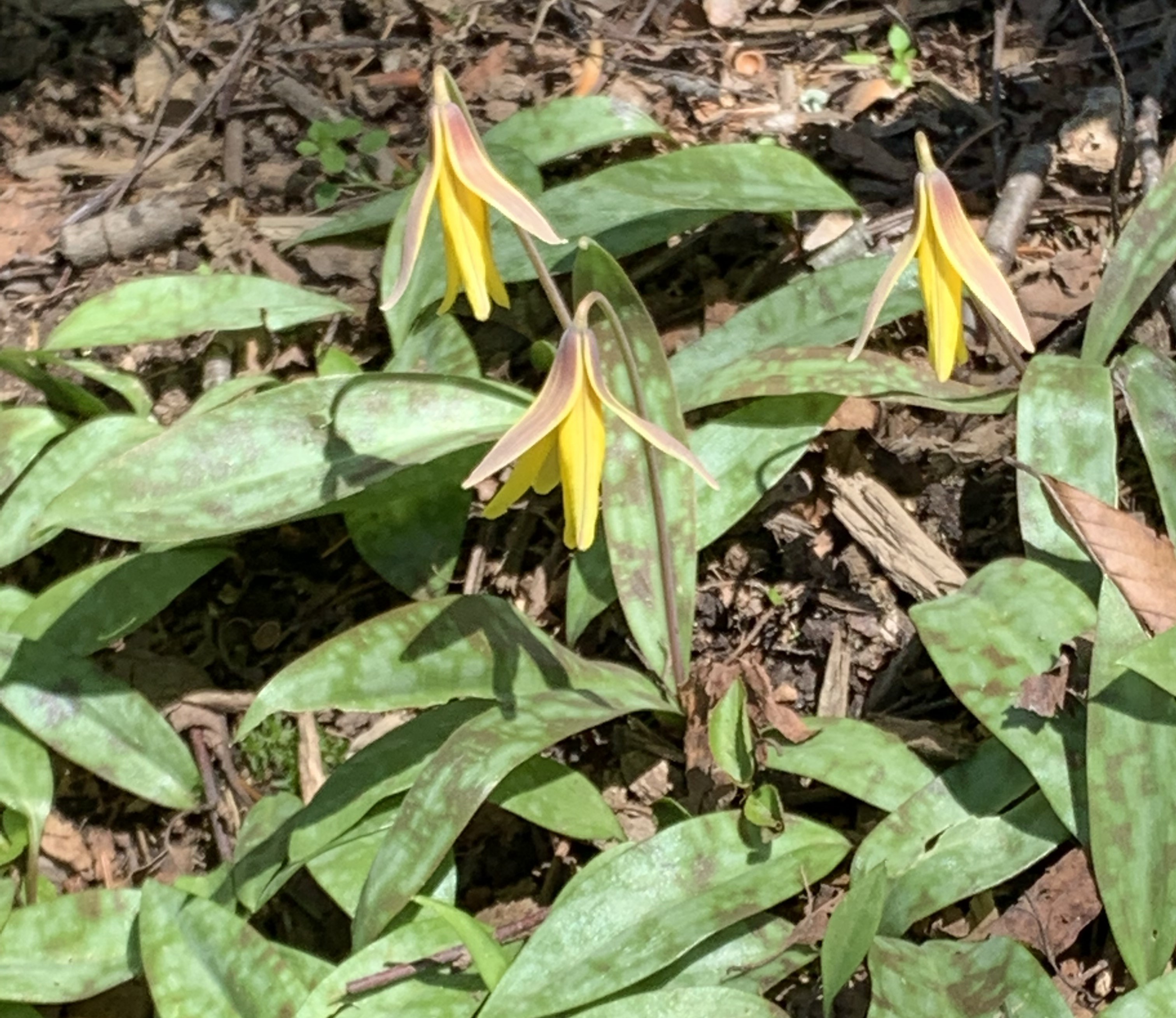
Yellow Trout Lily (Erythronium americanum) is a spring ephemeral.
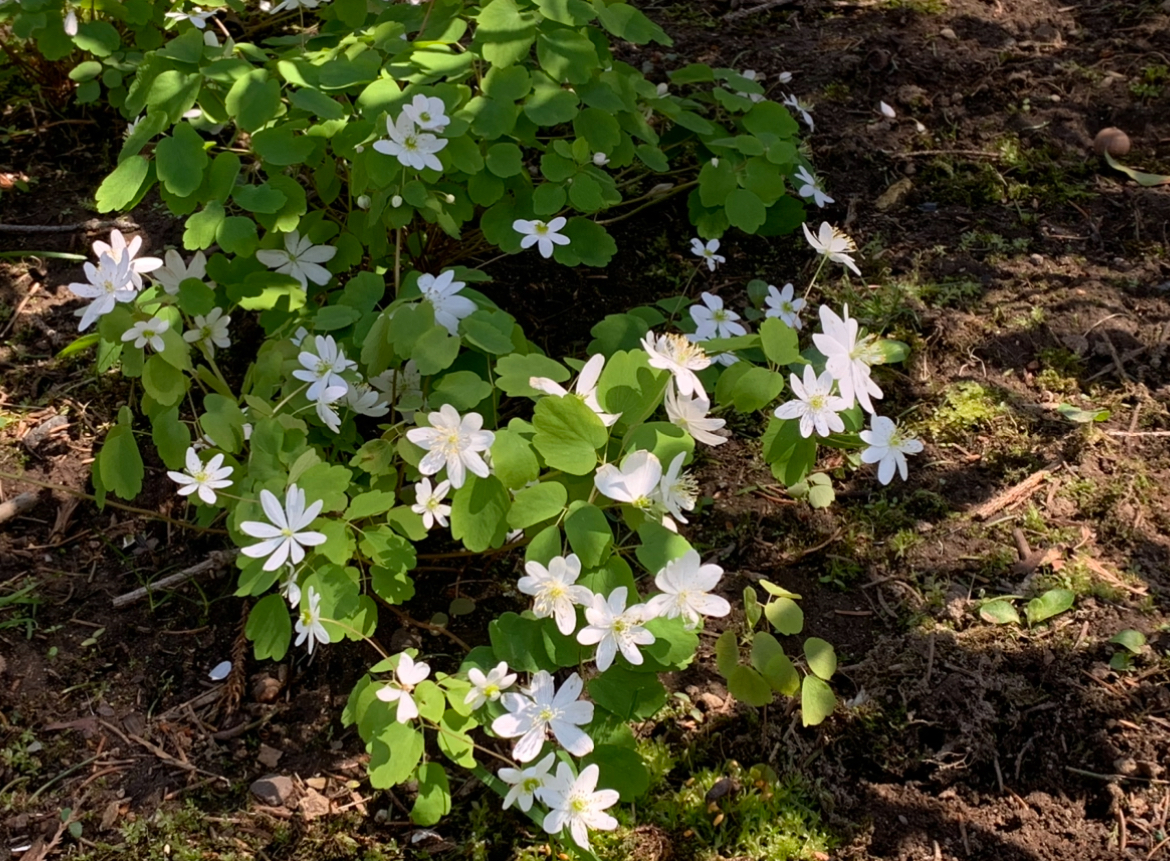
Rue Anemone (Anemonella thalictroides) blooms in early April, but will fade away in summer.
Spring ephemerals accomplish their entire active life cycle in a matter of 2 to 3 months. They must break through the soil, produce flowers, be pollinated, and set and disperse seed. Then, before sunlight is blocked by the tree canopy, they must photosynthesize enough nutrients to keep their underground roots or rhizomes alive through the next winter. Once they have done all of that, their leaves fade away in summer, and they rest again under soil and leaf litter until spring. “Ephemeral” means short-lived, but many of these plants actually live for years, spending most of that time underground.
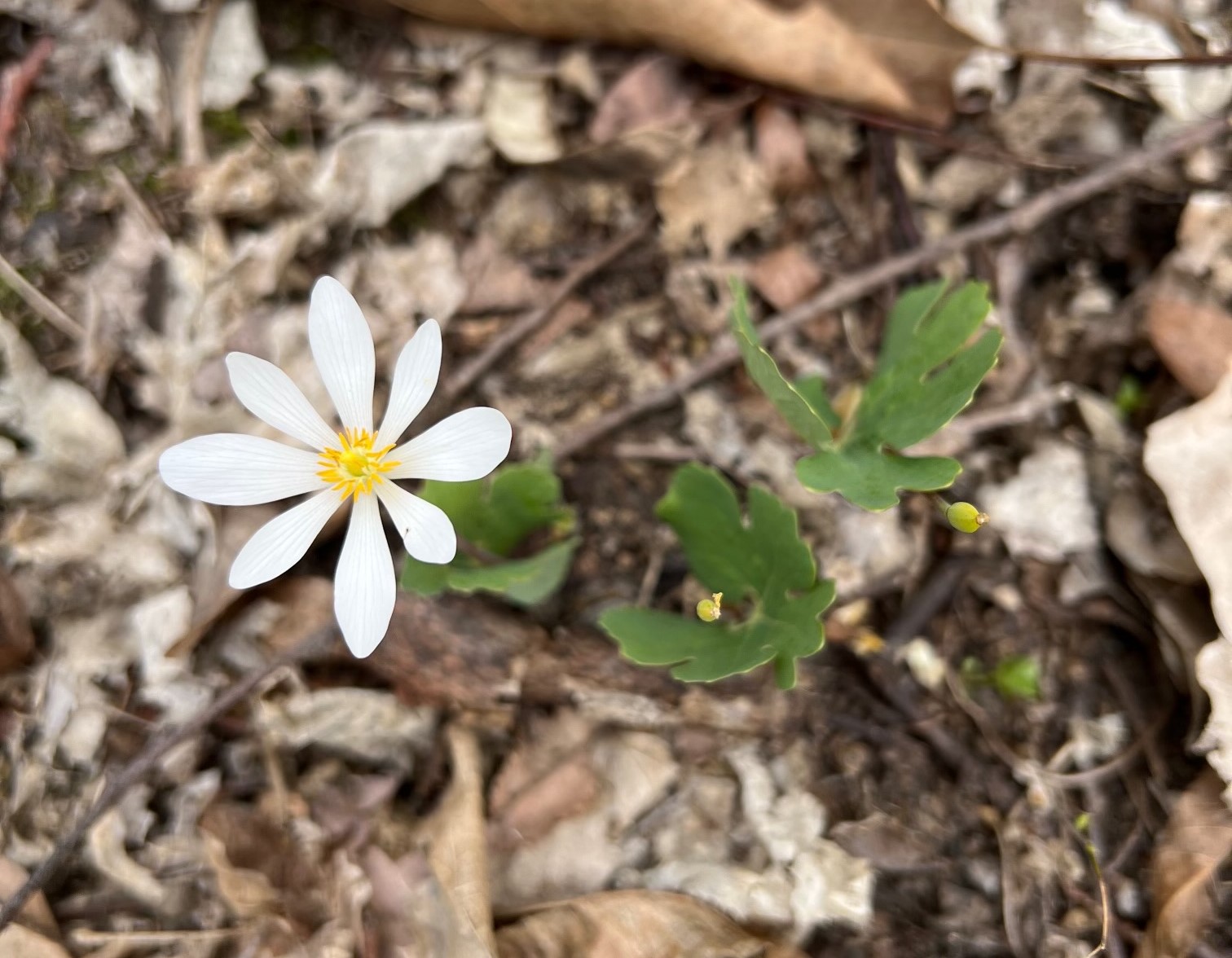
Bloodroot (Sanguinaria canadensis) is a spring ephemeral. Photo: Sandy Thompson
It’s a challenging life-style: there are late snowfalls and night-time freezes to withstand; pollinators are scarce in early spring; and there aren’t many birds available to disperse seeds. Most butterflies emerge much later, and birds are looking for insects for their babies in spring rather than seeds. So, spring ephemerals have co-evolved with specialized relationships to survive.
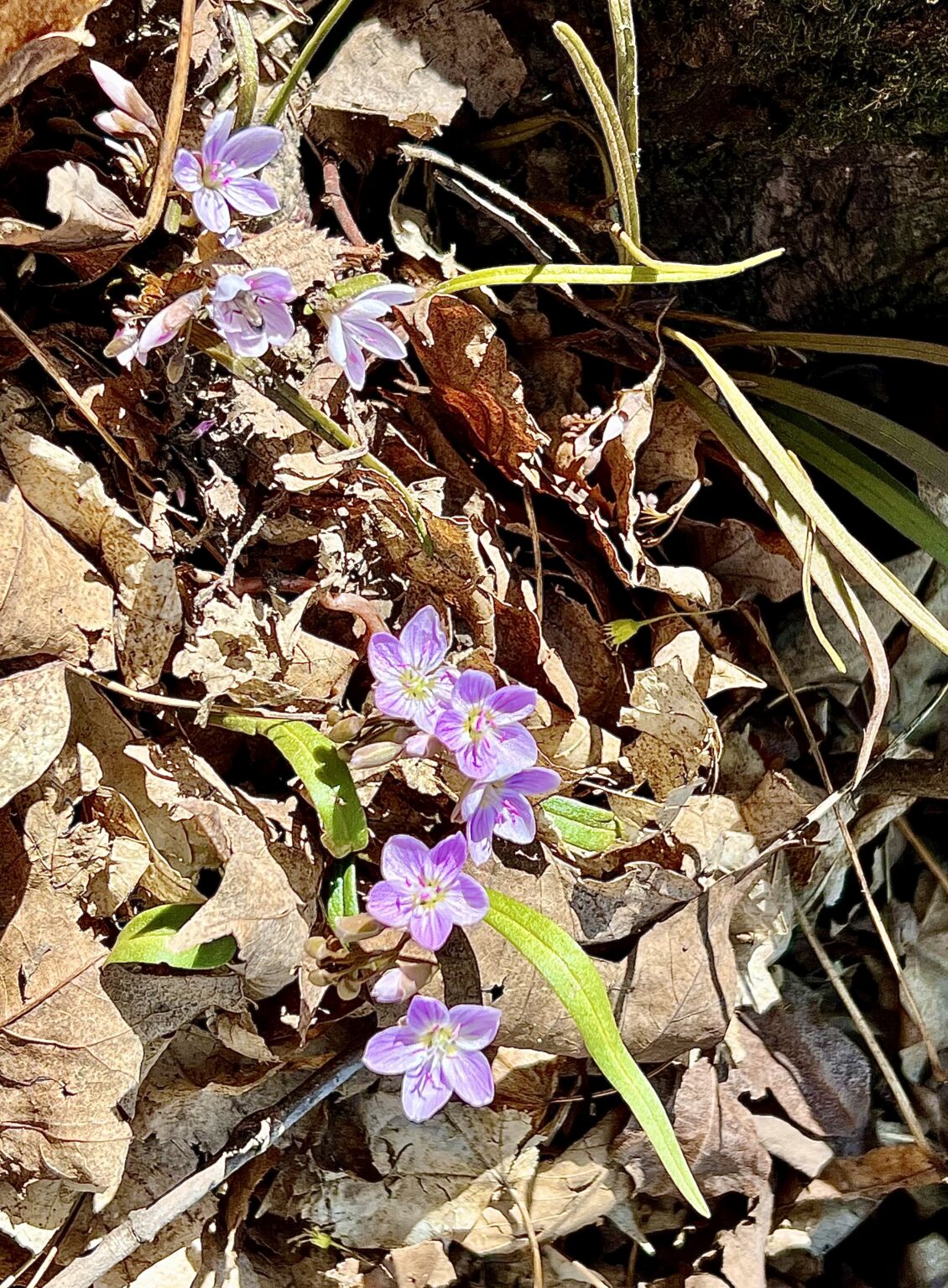
Spring Beauty (Claytonia virginica or caroliniana) Photo: Sandy Thompson
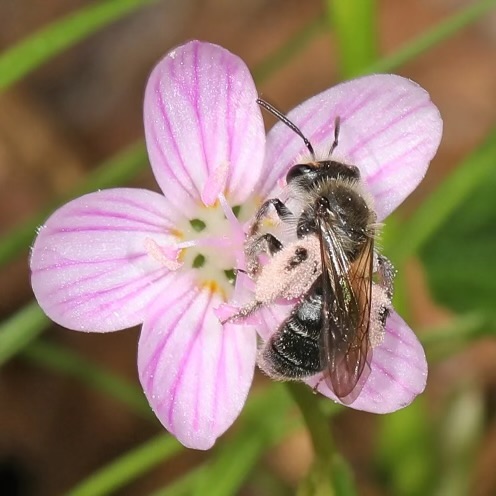
Consider the life cycle of Claytonia, commonly called “Spring Beauty,” a native wildflower as lovely as the name suggests. It blooms just at the same time that its pollinator begins searching for it. The specialized pollinator is a native bee, appropriately called the Spring Beauty Mining Bee (Andrena erigeniae), that overwinters in individual ground nests, usually under fallen leaves. Male and female bees emerge in very early spring. They mate and the males soon die off while the females begin excavating new nests in the ground (hence, the name “mining bee”). The females hunt for the pink pollen of Spring Beauty, the only pollen they can use, which they form into balls and place in the nest in individual brood chambers. The bee then lays a single egg in each chamber. The larvae hatch, feed on the pollen, develop into adults, and overwinter underground. The next spring, it all begins again.
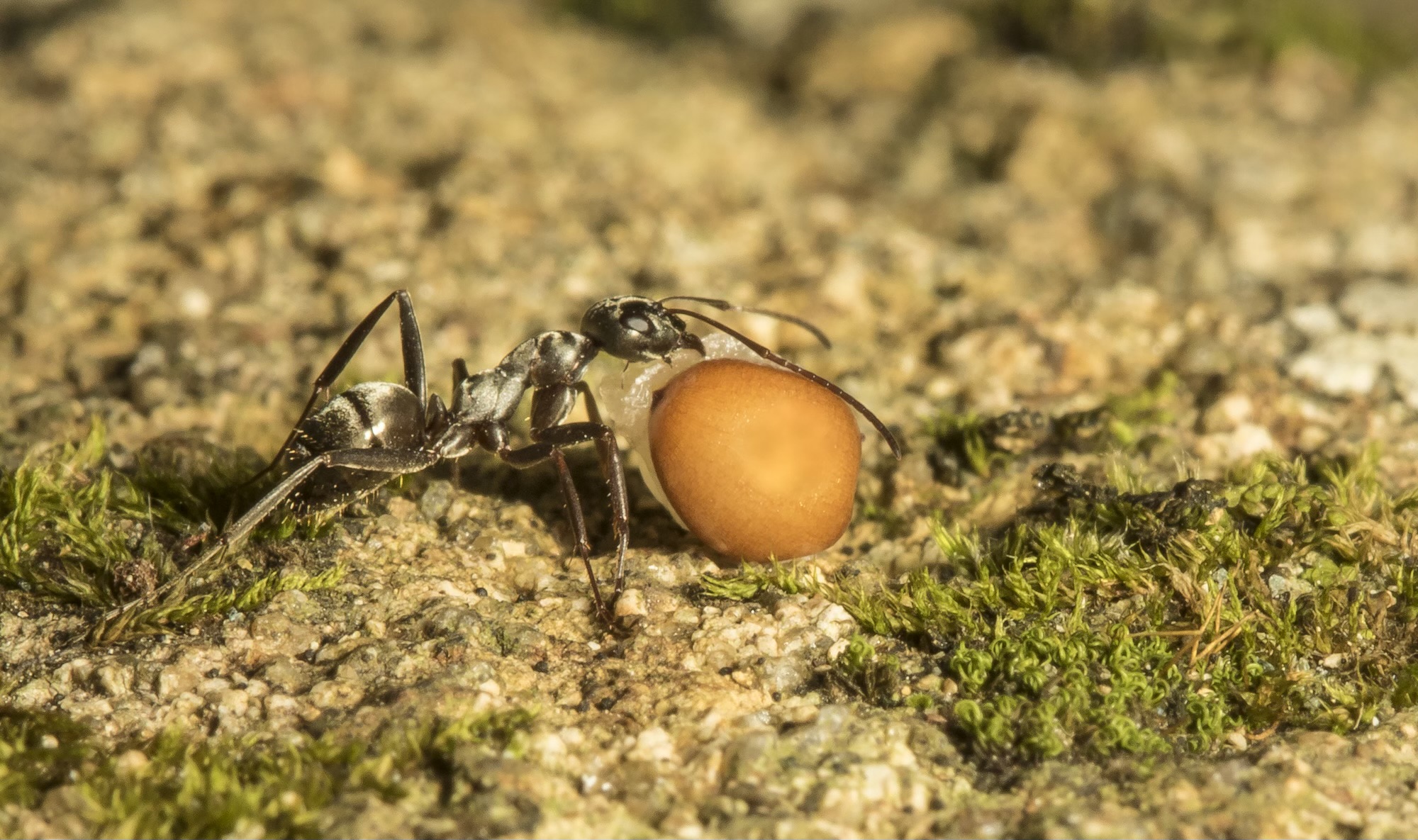
After pollination, Spring Beauty flowers produce seeds, each with an attached fatty mass called an elaiosome. The elaiosomes are particularly attractive to ants, who carry the seeds with the attached elaisomes back to their nests. The ant colony feeds on the elaiosomes and discards the seeds, effectively planting them nearby. This process of seed dispersal by ants is called “myrmecochory” and is common with spring ephemerals and other early-blooming native flowers. (See our earlier blog posts on Wild Ginger and Jeffersonia.)
An ant carrying a Trillium seed with attached elaiosome (greatly enlarged photo!!) Photo: Mike Dunn from “Roads End Naturalist” blog
So, with the help of its special insect friends, Spring Beauty is pollinated and its seeds are planted for the next year. In summer, its leaves will fade and the plant will disappear underground. But when the snow melts in spring, the plant will wake up again, eventually forming beautiful patches of candy-striped flowers on the forest floor – or, in a suburban shade garden!
Dicentra cucullaria, or “Dutchman’s Breeches”. Photo: Sandy Thompson
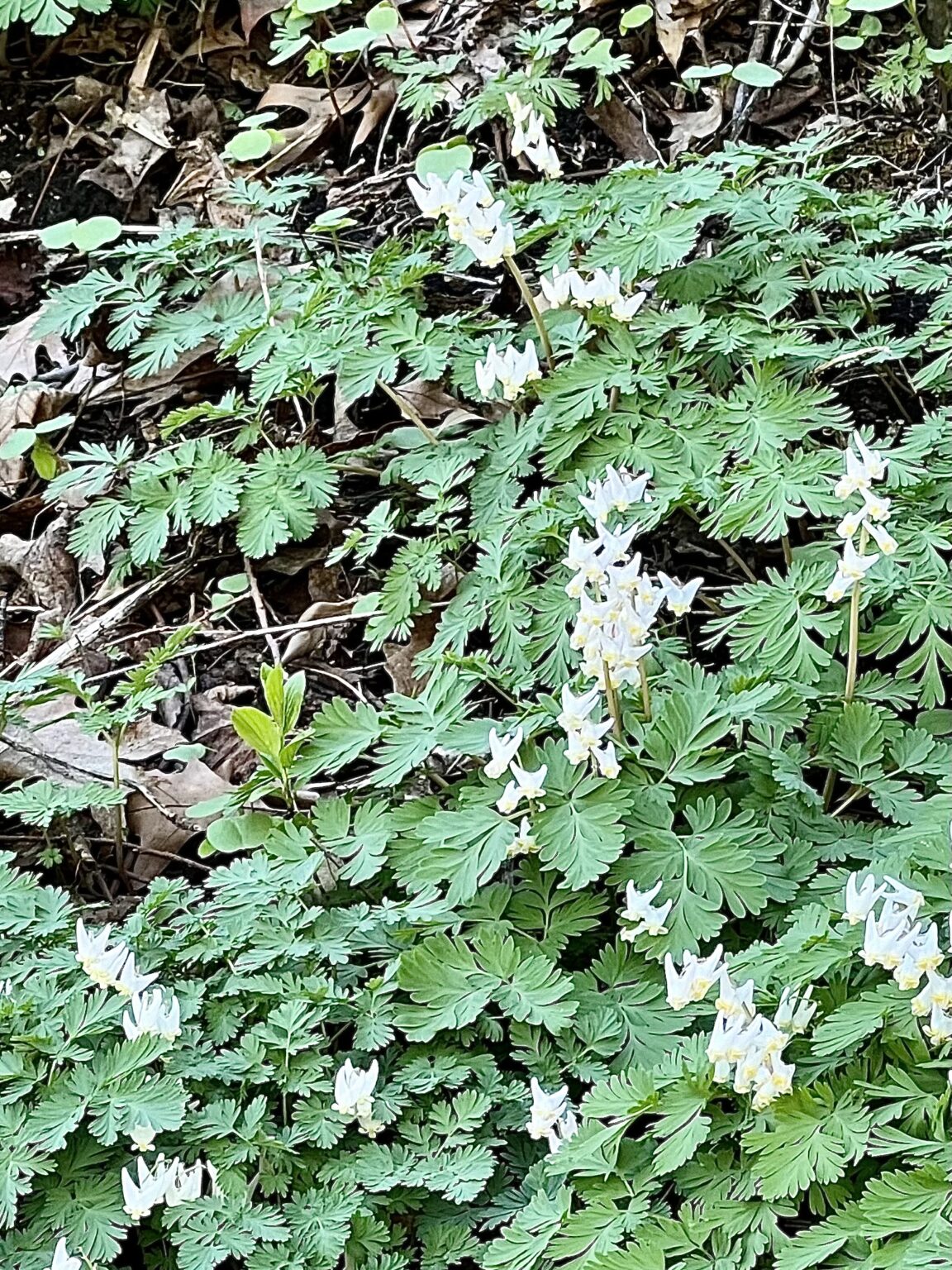
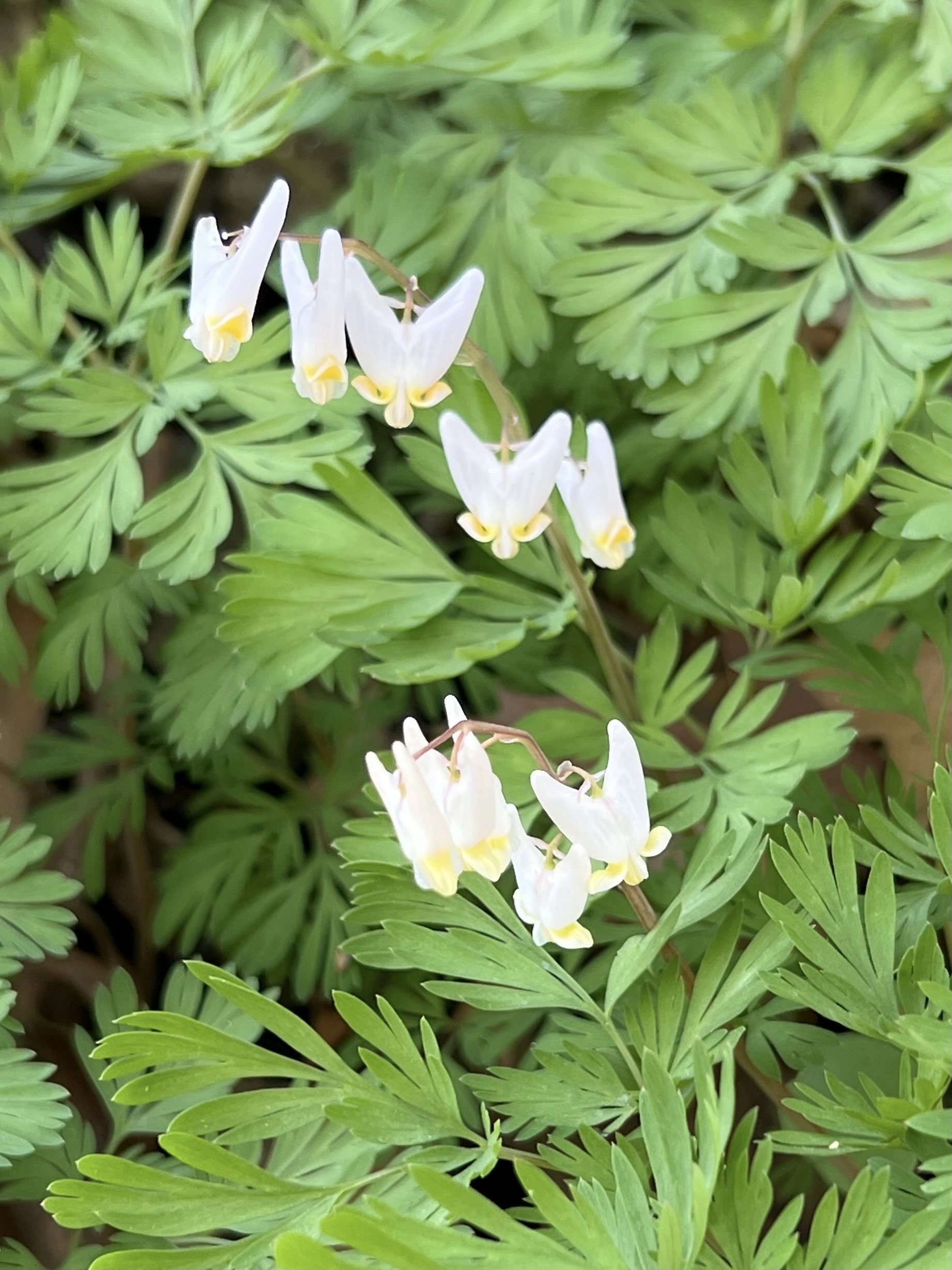
Another spring ephemeral with a special insect friend is called “Dutchman’s Breeches” because its white flowers look like old-style Dutch pantaloons. The flowers hold sweet nectar high up in the pointed flower tops where it can be reached only by long-tongued bees strong enough to force their way in and then escape through the tight opening. Queen bumblebees are perfect for the job. While worker bumblebees die off in the fall, queens over-winter as adults on the ground under leaf litter, and emerge just as Dutchman’s Breeches are flowering. They must find nectar to nourish themselves as they begin laying their eggs. There are not many flowers with nectar in early spring — even most spring ephemerals do not hold nectar — so Dicentra cucullaria is an important resource for queen bumblebees. In exchange for the nectar, the strong fuzzy body of the queen bumblebee carries pollen from flower to flower enabling the plant to produce seed.
Dutchmans’ Breeches flowers require a strong bee to pollinate them. Photo: Sandy Thompson
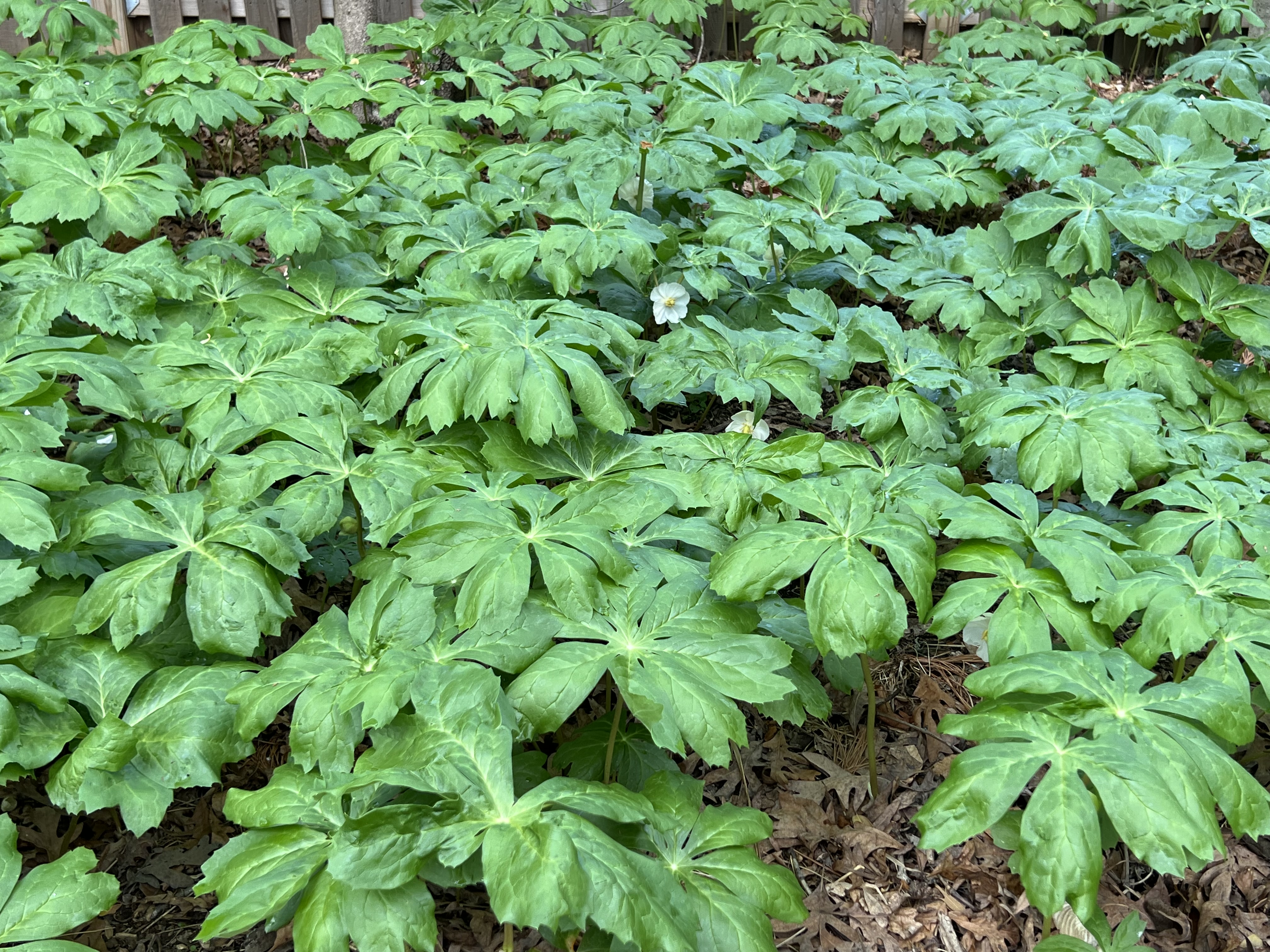
Still another spring ephemeral with a specialized relationship is Mayapple (Podophyllum peltatum).
A colony of Mayapple in April.
Mayapple flowers turn into fleshy “apple” fruits, about the size of a walnut. The fruit is prized by Eastern box turtles, and provides essential nourishment just as turtles come out of winter hibernation. In exchange, the turtles carry the seeds considerable distances, distributing them in their droppings to form new plant colonies. A recent study showed that Mayapple seeds that have passed through the digestive system of a box turtle have a higher germination rate than seeds distributed by other means! Mayapple can be found in wetland areas, woods, and in meadows where box turtles live, but it also makes a pretty spring show in a shady garden. It spreads somewhat aggressively by rhizomes, so it is a better choice for woodland areas than small gardens.
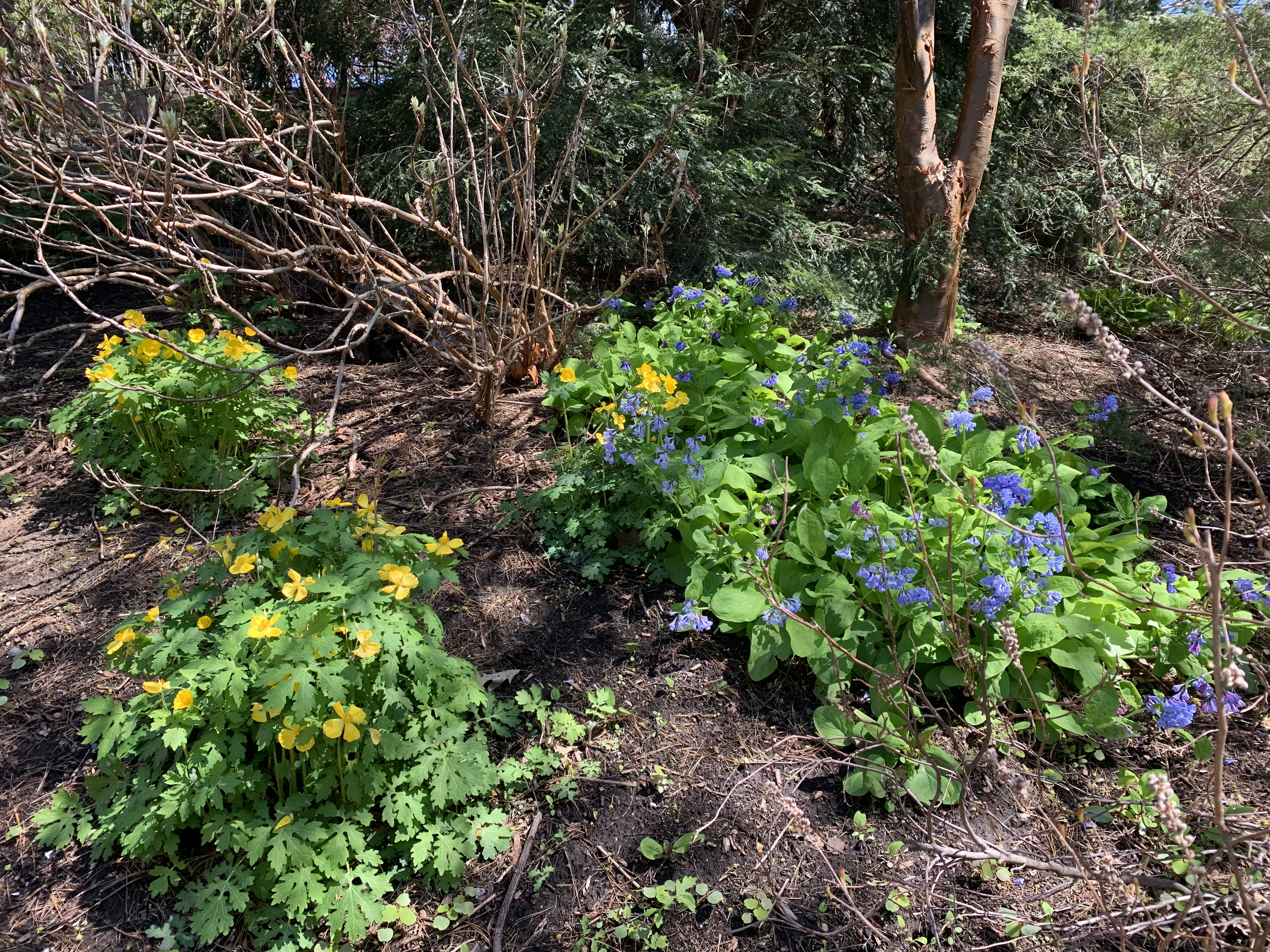
Virginia bluebells (Mertensia virginica) and Wood Poppy (Stylophorum diphyllum) are spring ephemerals that make great garden plants.
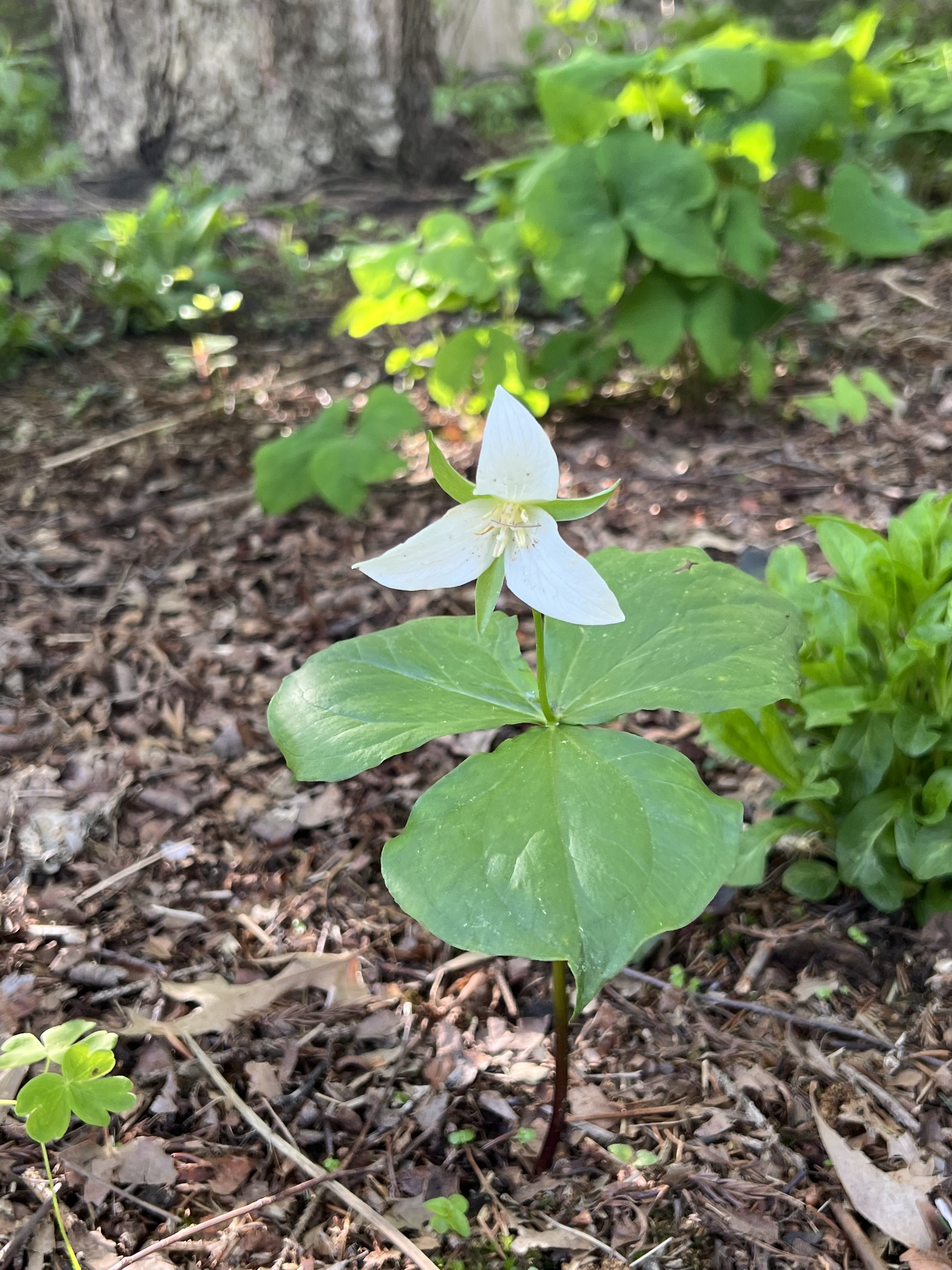
Trilliums are joyful spring ephemerals.
Native spring ephemerals evolved in Eastern forests, so they all do well in rich, slightly acidic soil enriched by fallen leaves that are allowed to decompose naturally. They are hardy in their native ranges, most of them from Canada south to Georgia and the Carolinas and west to the Mississippi River. They will disappear by late June or July, so plant them with other shade perennials that come up later: blue lobelia, wild ginger, maidenhair ferns, white wood asters, and goatsbeard are good choices, but so are many other native woodland plants. And allowing fall leaves to remain on the ground at least until mid-summer benefits not only the plants, but also their specialized insect and animal partners.
All of these plants offer critical food for early pollinators, but many spring ephemerals are disappearing in the wild as our forests are cleared, over-browsed by deer, and degraded with invasive species. Growing them in residential gardens is an act of ecological restoration — and a gift to our future.
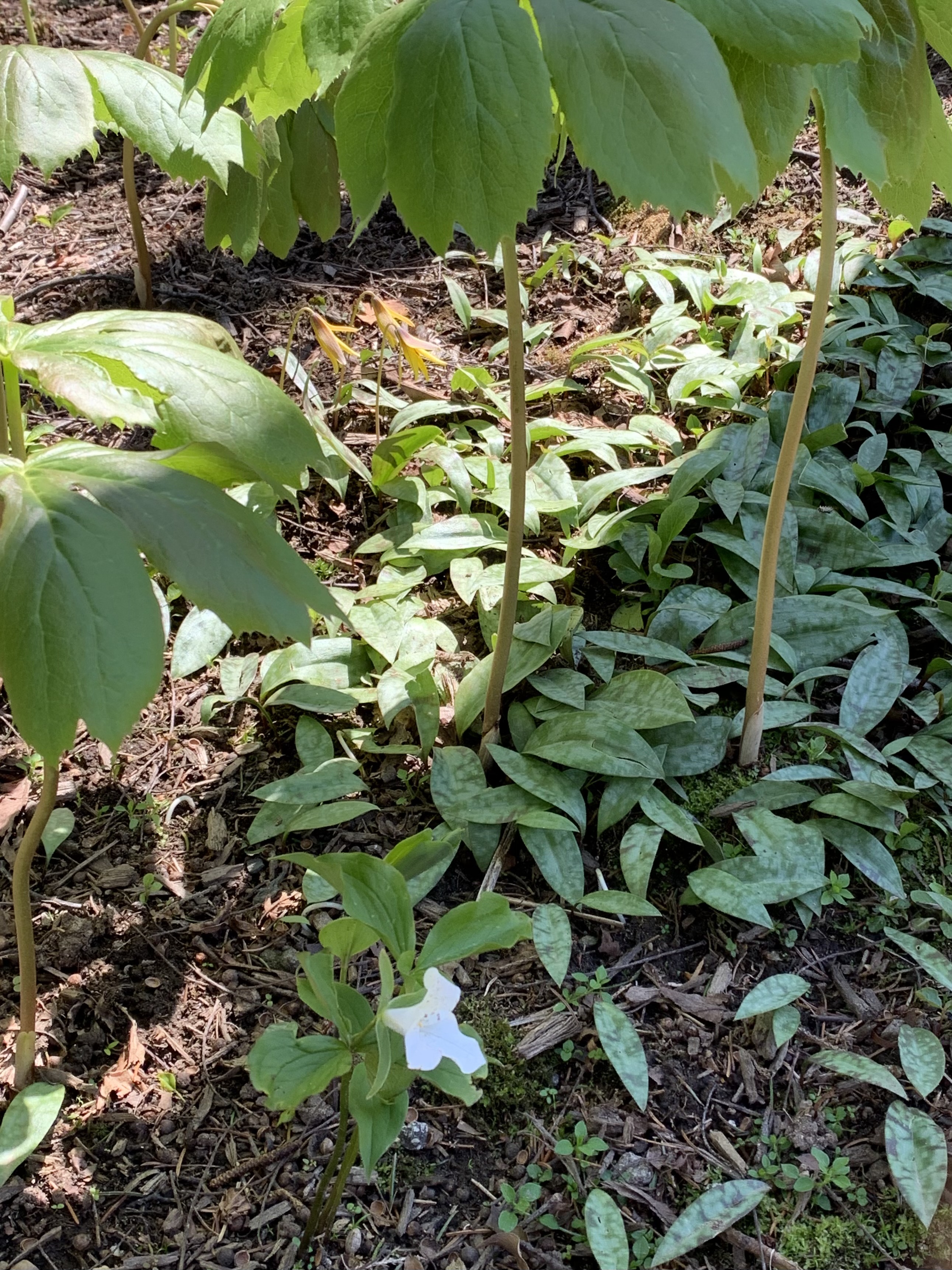
Mayapple, Trout Lily, and Trillium live together in a shady garden.
If you have mature trees, planting an array of spring ephemerals as a native understory is so much better than a mono-culture of non-native groundcovers (like pachysandra, ivy, vinca, liriope) or a layer of dead bark mulch. The specialized relationships these plants have with insects and other animals are fascinating and beautiful to observe. All of the plants discussed here are easy to incorporate into home gardens, and are available commercially and at native plant sales.
So, when spring is awakening in your yard, give these American beauties – and their special friends – a place to thrive.
THIS BLOG IS WRITTEN BY CATHY LUDDEN, CONSERVATIONIST AND NATIVE PLANT EDUCATOR; AND BOARD MEMBER, GREENBURGH NATURE CENTER. FOLLOW CATHY ON INSTAGRAM FOR MORE PHOTOS AND GARDENING TIPS@CATHYLUDDEN.